






FEEDBACK
April 2026

Plowed Under
JANUARY’S SNOWSTORM HIT DC LIKE A ton of, well, snowcrete, encasing roads and alleys in a rock-hard layer of icy precipitation. In some parts of town, the city’s response was slow and incomplete enough that neighbors pooled their resources and hired private plow companies to clear their streets. One of them, Chevy Chase DC resident Cindy Sherman, sent a proposal to two dozen neighbors to band together for such an effort, which came to $1,500, or about $62 a person. Instagram commenters on our web post agreed that sounded like a pretty good deal–but shouldn’t have been necessary.
“$62 to get going with a collective effort of a neighborhood is totally outstanding! Good on them.” —@dinwinddie9
“Love it and not a bad price. . . .” —@curriechicken202
“Their tax dollars paid for the service for the government to take care of this community. [Sherman] shouldn’t have had to do that.” —@msdeedee_2u
“Sometimes you have to take matters into your own hands. We can’t waste time waiting for public services sometimes.” —@renatalynettebeauty
“This happened in Foxhall too. Neighbors!” —@bavacuda
“Highlight the website and/or number of the service, so the larger community has it for the next time the city screws up.....this should also be [a] tax credit.” —@nkshahphotos
“Such a shame! DC collects so much money from traffic tickets. . . and yet this city can’t handle a snowstorm that happens once every ten years. Or maybe the mayor doesn’t care because she is not focused on being re-elected?” —@martinvdr1
“Millions in traffic tickets and they still have yet to clean these streets. Where is that money going?” —@les.s.more
Comments may be edited.
PHOTOGRAPH IN SCREENSHOT BY DAVIN G PHOTOGRAPHY/GETTY IMAGES





TAKING FLIGHT
The National Air and Space Museum will open new galleries this summer. For more, turn the page.
PHOTOGRAPH BY MARK AVINO/NATIONAL AIR AND SPACE MUSEUM
DEPARTMENTS
The End Is in Sight!
Four long-term projects finally near the finish line

A rendering of the sculpture garden
SEVERAL DC MUSEUMS AND MONUMENTS have been undergoing much-anticipated renovations that are now heading to completion. Here’s a preview.
NATIONAL AIR AND SPACE MUSEUM
The museum will debut the last phase of its major renovation this year, with five of the seven remaining exhibit halls reopening in conjunction with the America 250 celebration—and the museum’s 50th birthday—in July. You’ll be able to explore the mechanics of space flight, check out a P-51D Mustang and other WWII-era airplanes, and, in the RTX Living in the Space Age Hall, learn about how spaceflight technology has affected life on Earth. When the last two exhibits arrive later in the year, this long-term overhaul of the beloved museum will at last be complete.
NATIONAL GEOGRAPHIC MUSEUM OF EXPLORATION
As part of a broader renovation of National Geographic’s headquarters, the museum is being significantly expanded and rethought. You can check out the new space this summer when it opens with exhibits about exploration and conservation. The museum will also feature a 400-seat theater, a nighttime courtyard, and a new explorer’s eatery offering cuisines from across the globe. Visitors will enter through a tall, yellow rectangle that will be instantly recognizable to fans of National Geographic magazine.
HIRSHHORN SCULPTURE GARDEN
If you’ve spotted a bronze-toned toe sticking up behind the construction scaffolding, that’s just a peek into the museum’s upcoming sculpture area, which has been undergoing an extensive revamp since 2023. The revitalization is slated to be completed in late fall and will include things like increased seating, a cistern for improved drainage, additional trees for shade, and a total of five entrances to the garden, up from three. Stackedstone walls will be built throughout the garden’s East, Central and West galleries, and there will be space for performances and rotating exhibitions.
LINCOLN MEMORIAL UNDERCROFT
Since 2023, the memorial’s undercroft—the foundation that was built to bear the weight of the structure—has been getting a major transformation. The project will create 15,000 square feet of exhibit space that’s dedicated to the 16th President. Additional planned renovations include an immersive theater equipped with historic images; a new elevator and restrooms; and a larger gift shop. The new space is likely to open by July 4.
—JENAE BARNES
RENDERING COURTESY OF NMRL/DARCSTUDIO

CAPITAL COMMENT
Recipe for Hope
An Army veteran’s online show focuses on food and mental health

Cory Brown, cohost of Eat Your Feelings
IT WAS A POINT OF PRIDE FOR CORY Brown’s unit: Despite their dangerous mission providing convoy security along the highways of northern Iraq, all of the nearly 200 soldiers survived the war. Then they got home.
Since 2008, when his cavalry regiment returned to the US, more than 20 of the soldiers have died, most apparently by suicide. That includes Brown’s closest Army friend, Kevin Zachary, who lost his life to suicide in 2019. “When you look back and start piecing things together, he had a lot of medical bills, he was having trouble with the bank and housing, his job and the relationships that he had,” Brown says. “All these things had hit him, and he wasn’t talking to us about them, or at least he wasn’t telling anybody all of it.”
Zachary’s death was devastating for Brown, who had been hit by an IED in Iraq, suffered a traumatic brain injury, and struggled with his own reentry. He got divorced, had trouble finding the motivation to work, and dealt with suicidal thoughts himself. “I thought I would be more adjusted, but life has a way of showing you that you don’t know what you’re talking about,” says Brown, who grew up in Alabama and today lives in Nokesville, Virginia.
Before shipping off, Brown had attended graduate school in political management at George Washington University, and when he got back, after a rough period in Alabama, he moved to the Washington area and worked as a campaign consultant and pollster. But after his friend’s death, he searched for opportunities to help struggling veterans talk more openly about—and seek help for—their mental health.
That’s why last year Brown debuted Eat Your Feelings, an online cooking show that incorporates honest discussions about grief, loneliness, and stress. Brown hosts the show with Sam Nathews, a beverage lobbyist who grew up in the next town over from Brown’s in Alabama—though the two never met until they were on a panel together in DC a decade ago.
Cooking, it turned out, was the perfect way for the two friends to talk about intense subjects while keeping the conversation lively. “We’ll be laughing one minute, we’ll be crying the next minute, and then setting off the fire alarm the next minute,” Nathews says. Both have been into cooking for years. Brown’s fondest childhood memories are of big country breakfasts his grandmother made, and Nathews’s father owned a barbecue trailer that served a famous jambalaya, which the pair try to recreate in one episode while also talking about the loss of parents and friends.
Though it deals with heavy subject matter, Eat Your Feelings—nine more episodes are coming to YouTube soon—is casual and unscripted. Nathews joshes with Brown and makes off-color jokes, filling up the show’s virtual “swear jar.”
But both have also cried on camera. “The cooking can be fun and the comedy can be funny,” Brown says, “but at the end of the day, it’s got to be about that stuff that nobody wants to talk about.”
—IKE ALLEN

PHOTOGRAPH OF BROWN BY MELANIE BLAKELY; HOUSE BY APK/WIKIMEDIA

CAPITAL COMMENT
CAPITAL COMMENT
Not a Pretty Picture
Hemphill Artworks, one of DC’s key galleries, closes its doors
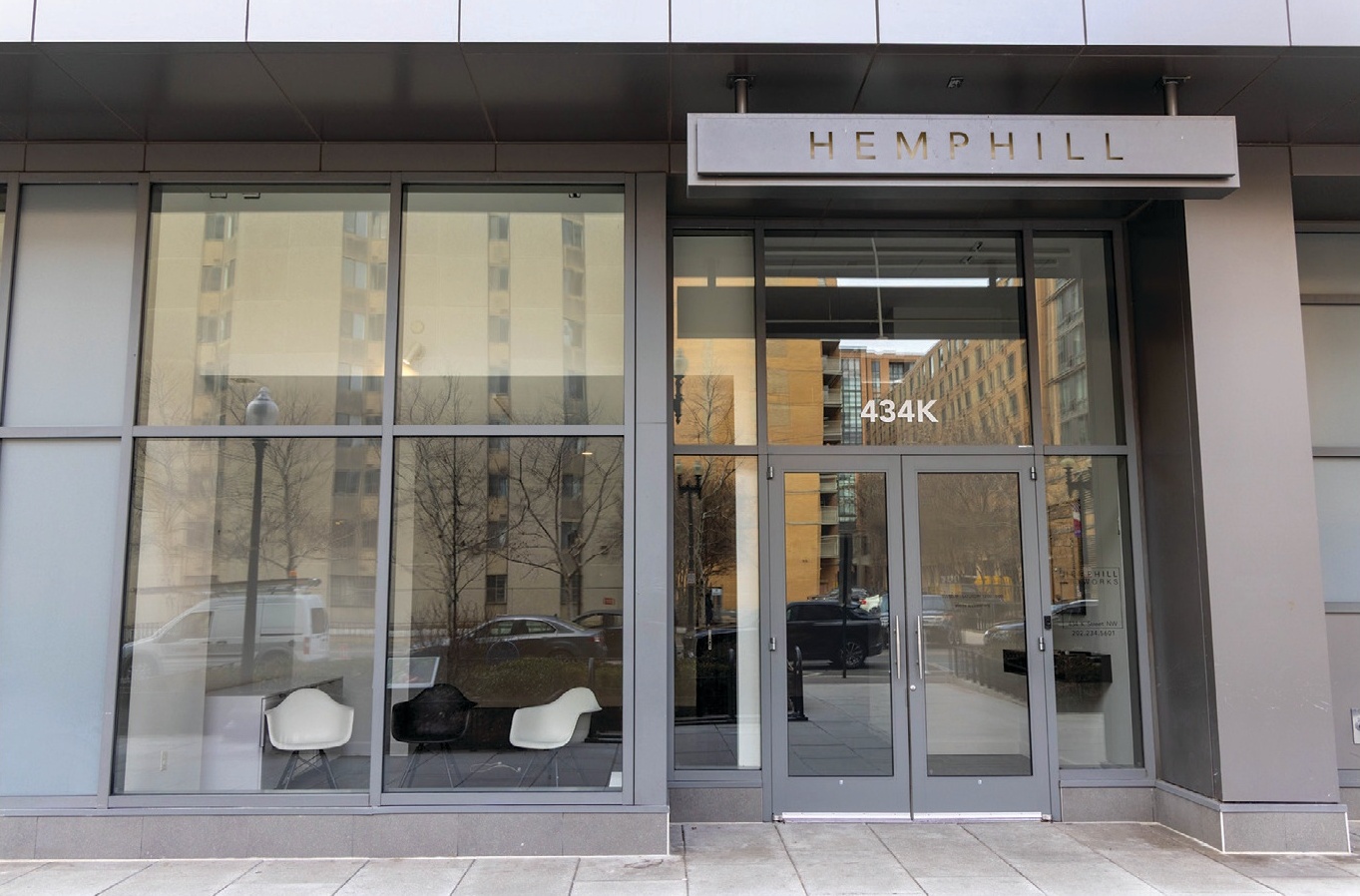
The now-shuttered Hemphill space
HEMPHILL ARTWORKS, ONE OF DC’S most important art galleries, has closed its location in Mount Vernon Square, a sign of the challenges facing art dealers across the country. Founder George Hemphill, who declined to comment for this story, recently sent out an email announcing he would still represent artists and sell work, but there will no longer be a public-facing space and the gallery won’t host regular exhibitions.
The loss for the District is enormous: Hemphill is one of the few DC galleries that show new work by mid-career and established artists, including Renée Stout and Robin Rose, along with younger rising stars like Melvin L. Nesbitt Jr. and Rush Baker IV. It also represents the estates and late works of several local luminaries, including Color Field painter Leon Berkowitz, Southern Gothic photographer William Christenberry, and pastel realist Kevin MacDonald.
There have been signs of trouble leading up to the closure. Painters Linling Lu and Hedieh Javanshir Ilchi have left the gallery in recent years. (The artists did not return requests for comment.) Hemphill is also a defendant in an ongoing lawsuit over the sale of a painting by Alma Thomas. A woman named Gwendolyn Clark claims that a painting by Thomas that she bought with her husband in 1976—which went missing in 1981—was subsequently purchased and resold by Hemphill after she told the gallery she was searching for it. (L. Eden Burgess, an attorney for Hemphill Artworks, says George Hemphill denies Clark’s allegations.)
George Hemphill opened Hemphill Fine Arts in Georgetown in 1993, then moved to 14th Street, Northwest, in 2004, helping spur that corridor’s revival. The gallery relocated to 434 K Street, Northwest, in 2019 and rebranded as Hemphill Artworks.
One of the gallery’s triumphs was its discovery of the DC artist known as Mingering Mike. After a record collector found a cache of richly illustrated vinyl records made from cardboard at a flea market in 2004—an archive of a vibrant and completely imaginary career in soul music—Hemphill was the first to show them. The gallery helped place the collection at the Smithsonian American Art Museum.
The loss of Hemphill’s physical gallery leaves the city without a space to see some of the region’s best contemporary artists. But in Hemphill’s email, he pledged that the gallery will find other ways to make shows happen. “We are not abandoning our ambition to curate and mount exhibitions,” he wrote, “but we will be looking for circumstances more favorable to the changing environment.”
—KRISTON CAPPS
PHOTOGRAPH BY EVY MAGES

CAPITAL COMMENT




PHOTOGRAPH OF HEATED RIVALRY ACTORS BY JULIAN HAMILTON/GETTY IMAGES (LEFT) AND HAROLD FENG/GETTY IMAGES; KENNEDY BY MITCHELL GERBER/GETTY IMAGES; BAD BUNNY BY ETIENNE LAURENT/AFP VIA GETTY IMAGES
CAPITAL COMMENT
Emissions Inspection
Why are University of Maryland scientists studying farts?

HOW OFTEN DO PEOPLE FART? THAT pressing question is currently being studied by scientists at the University of Maryland. Microbiologist Brantley Hall and his colleagues are attempting to map something scientists have largely ignored: the patterns and frequency of everyday human gas. “What’s really fascinating,” says Hall, “is that we don’t know how often people are farting.” The few studies that have tried to measure that relied on invasive techniques like rectal tubes, and most were conducted decades ago. “One in five people report excess intestinal gas,” he says. “But if we don’t know what normal is, we don’t know what excess is.”
That’s why Hall is working on something called the Human Flatus Atlas, an attempt to create the first large-scale data set of everyday human gas. The project involves a “smart underwear” device that Hall has been developing since 2020. A first-of-its-kind contraption designed to reveal what your farts say about your gut health, the device is a small sensor that the user places in their underwear to record whatever passes through it. The resulting data goes to an accompanying iPhone app and then is uploaded to servers so that users—and researchers—can track gaseous trends. Apparently, people are quite curious about their gut health: More than 7,300 have signed up to participate so far.
The demand has surprised even Hall, who initially expected only dozens of volunteers. The wave of responses has prompted the team to greatly expand production of the smart-underwear devices. The goal is to capture a broad cross-section of participants across age, diet, and lifestyle. Participants are asked to wear the device—which the team describes as “comfortable”—for at least three days. Hall has been using one himself for more than a month.
Beyond the team’s 2025 study, researchers are planning collaborations with universities across the country to expand the data and refine the technology. Hall says there’s plenty more to study, such as the ways that some foods and diets are connected to flatulence. “Right now, a major impediment for switching from a low-fiber diet to a high-fiber diet is the crazy gas symptoms you get,” he explains. “We’re trying to find a way to make that switch easier. Imagine a future where you could eat healthy without experiencing excess intestinal gas.”
Eventually, Hall hopes the device could move beyond the lab and into the wellness market. “Hundreds of people have emailed asking to be part of the study, so there’s definitely some demand in the reduction-of-gas space,” he says. “We would love for it to be a mass-produced product.”
—TRISTAN ESPINOZA
UNDERWEAR COURTESY OF BRANTLEY HALL
CAPITAL COMMENT
BANNER YEAR
The Trump administration seems unnervingly fond of hanging authoritarian-style banners with his glowering face on federal buildings. Here’s a closer look.
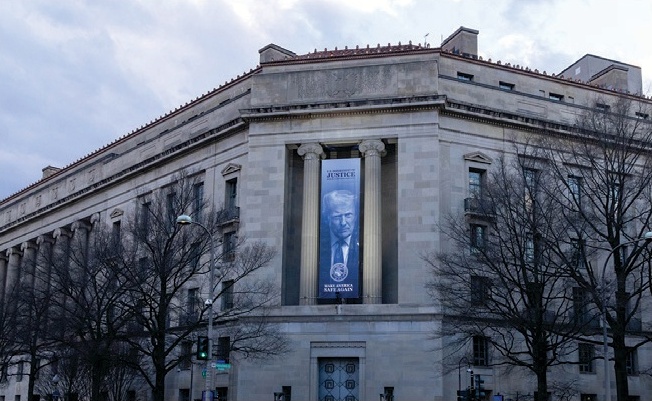
DEPARTMENT OF JUSTICE
Recently, a gray-blue banner of the President appeared on the side of DOJ headquarters. A slogan on the bottom of the sign reads “Make America Safe Again.” The department–which is supposed to function independent of presidential influence–said the sign was somehow meant to commemorate America’s 250th birthday.

DEPARTMENT OF LABOR
A full-color banner of a frowning Trump adorned the front of the building last August, branded with the “America 250” logo. The image was hung with one of Teddy Roosevelt, along with the phrase “American Workers First.”

DEPARTMENT OF AGRICULTURE
Two banners appeared on the USDA headquarters last May: one with a portrait of Trump, the other with an image of Abraham Lincoln. A message on the signs nodded to Lincoln’s role in establishing the agency: “Growing America Since 1862.” The banners, which cost more than $16,000, were taken down a few months later.
–DARA T. MATHIS
PHOTOGRAPHS FROM TOP, BY EVY MAGES, DEPARTMENT OF LABOR, AND ANNABELLE GORDON/SIPA USA
CAPITAL COMMENT
Grindr Gets Political
Why the LGBTQ+ dating app launched a DC policy operation
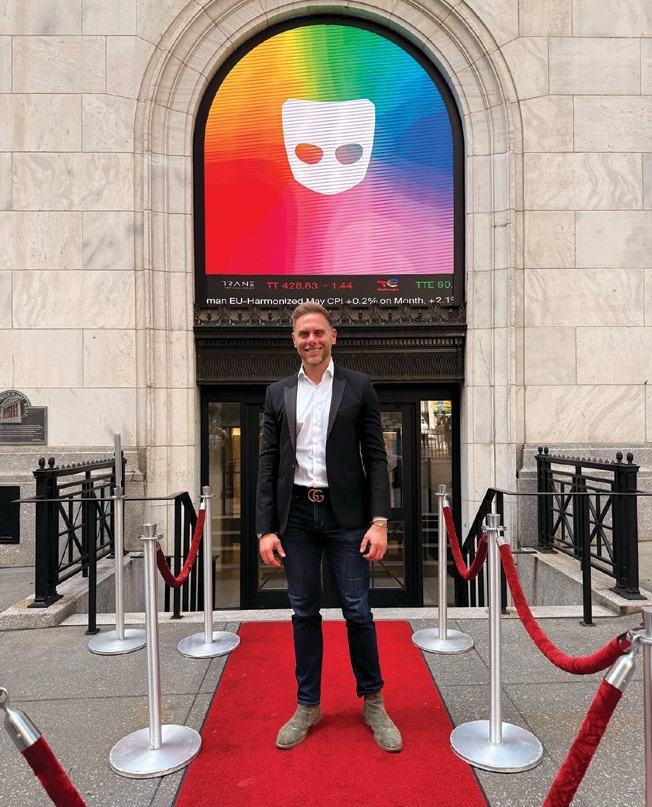
Grindr’s Joe Hack
GRINDR, THE WORLD’S LARGEST LGBTQ+ dating and hookup app, has been popular in DC for more than a decade. But last year, the company did something unexpected: It launched a Washington policy operation, naming Joe Hack as its first head of global government affairs. So why does a hookup app need a policy wing?
Hack, a former congressional aide and executive at the Daschle Group, has been advocating on behalf of the app’s 15 million users, making the rounds on Capitol Hill. Part of his job is reframing what Grindr actually is. Beyond quick encounters and shirtless grid photos, he argues, the company operates at the intersection of technology, identity, and wellness. “Grindr is not just a tech company or the largest gay company on the planet,” he says. “It’s also a public-health company.”
As anti-LGBTQ+ rhetoric has put increasing pressure on access to healthcare, Grindr has expanded its role as a discreet place for users to access things like medications and free HIV self-testing kits. In 2025, it launched the telehealth service Woodwork, allowing users to request prescriptions for medications such as erectile-dysfunction treatments directly through the app.
Hack says the company continues to receive bipartisan federal support as one of the CDC’s top partners in HIV prevention, a situation that hasn’t changed under the Trump administration.
Grindr is also pressing lawmakers on issues like digital safety and privacy. Over the past year, Hack has lobbied in support of the App Store Accountability Act, which would require app stores—not individual apps—to verify user ages before downloads. The goal, he says, is to prevent minors from accessing adult platforms without forcing them to submit facial scans or upload government-issued IDs, methods that critics argue are invasive and prone to error.
Hack says the company is still figuring out where it can have the greatest impact. Grindr remains, in his words, a “sexy brand”—and much of his time on Capitol Hill is spent explaining the realities of LGBTQ+ life to lawmakers who may be unfamiliar. He’s also having conversations with legislators to advocate for continued global HIV-prevention funding, framing it as a human-rights issue.
Next on the agenda: expanding access to legal aid, supporting LGBTQ+ family-formation rights—including tax equity for same-sex couples and surrogacy protections—and finding ways to carefully integrate AI into the Grindr app. For the first time this year, the company will also host a party for the White House Correspondents’ Dinner.
At the moment, Grindr’s DC operation is just Hack, who works from home. But the plan is to open a physical office and also expand the team, signaling that Grindr’s policy presence is more than an experiment. “Managing 190 countries, 50 states, and a federal government as one human is not the easiest,” Hack says. “I’m excited to have help.”
—TRISTAN ESPINOZA
HACK COURTESY OF GRINDR
CAPITAL COMMENT
Guest List
A monthly roundup of people we’d like to have over for drinks, food, and conversation

1. Anthony Davis
Some rare good news for the beleaguered Wizards: This big NBA star is now on the team.
2. David Strasser
He’s the next CEO of the José Andrés Group. Andrés stepped down from the job in 2024.
3. Jon Bernthal
The actor, who grew up in Maryland, recently bought a house in Chevy Chase DC.
4. Emily Calandrelli
Known as the Space Gal, the TV host, aerospace engineer, and social-media star is now living in the area.
5. Candace Buckner
The renowned sports columnist is among the former Post writers recently snapped up by the Athletic.
PHOTOGRAPH OF DAVIS BY SCOTT TAETSCH/GETTY IMAGES; CALANDRELLI BY JASON DAVIS/GETTY IMAGES FOR BENTONVILLE FILM FESTIVAL; BERNTHAL BY ALBERTO E. RODRIGUEZ/GETTY IMAGES FOR CINEMACON
CAPITAL COMMENT
Lowering the Bar
What does it mean to open a “pop-up dive”?

EXACTLY WHAT MAKES A DIVE bar is a matter of great debate. But regardless of whether there’s graffiti in the bathroom stalls or a jukebox in a dimly lit corner, one universal quality is that its character comes from age. So it might raise eyebrows that a “pop-up dive bar” is operating in Alexandria from late March through the summer.
Del Ray Dive is the latest from Del Ray’s Pop Up Bar, an ever-changing venue that has previously been devoted to Taylor Swift, tiki, and ski-lodge themes. “How can you have a dive bar that’s been there for generations but it’s really only been there for, like, three weeks?” says owner Bill Blackburn. “That’s a fair question. I guess it’ll be a fair critique. But we’ll do our best.”
Blackburn’s original idea was to create a throwback to the old Del Ray, when it was a more blue-collar neighborhood full of “drown-your-sorrows-with-a-shot-and-a-beer-type bars,” he says. “But that’s not very fun, right? Nobody wants to go to a dive bar that’s depressing.” Instead, he wants to channel college dive bars or the kind of places you might go to in your twenties, “because everybody has fond memories of that time in their life, whether you went to college or you didn’t.”
Blackburn says you can expect an old jukebox and darts, along with sports and college memorabilia and neon signs. Part of Del Ray Dive pays homage to real dive bars of Alexandria, such as Mac’s Place, the Snuggery, and the Cole Bin. “Everything’s on the cheaper side, which is kind of a change in formula from what we’ve done in the past with this pop-up,” says Blackburn, who hopes to keep drinks under $10 and offer happy-hour deals. “We can’t have a dive bar and then sell old-fashioneds for $18.”
He has also bought a soda machine he plans to rebrand as the “beer-o-matic” and stock with PBR, Natty Light, and other cheap cans. “For four bucks, the bartender just presses a button and you get whatever comes out.”
One aspect is decidedly inauthentic, however. The bar shares its restrooms with the adjoining Pork Barrel BBQ, so Blackburn says the stalls will be “cleaner than a dive bar should have.”
—JESSICA SIDMAN
DRINKS BY GETTY IMAGES

CAPITAL COMMENT / BIG PICTURE

Branching Out
ON AN OVERCAST DAY IN MID-FEBRUARY, a crew of contractors offloaded rows of cherry trees and various saplings to a staging area near the Tidal Basin. Most of the cherry trees, seen here in a row on the left, were waiting to be transported to the south side of the reservoir. The other trees were intended to fill in gaps around the National Mall. With their root balls wrapped to keep them moist, the saplings stayed in the staging area for up to ten days. Contractors began transplanting them with the help of the National Park Service soon after.
In 2024, the Park Service removed about 150 cherry trees as part of an ongoing program to rehabilitate the seawall around the flood-prone Tidal Basin. The Japanese government pledged a gift of 250 trees last year to replace them. Some of those are native Japanese cherry trees, currently under a two-year quarantine. But most were grown in American commercial nurseries, and some are now being moved to their permanent homes. You’ll be able to see them this year along with those famous pink blossoms on the remaining mature trees.
—DARA T. MATHIS
PHOTOGRAPH COURTESY OF NATIONAL PARK SERVICE
DEPARTMENTS

CAPITAL COMMENTS

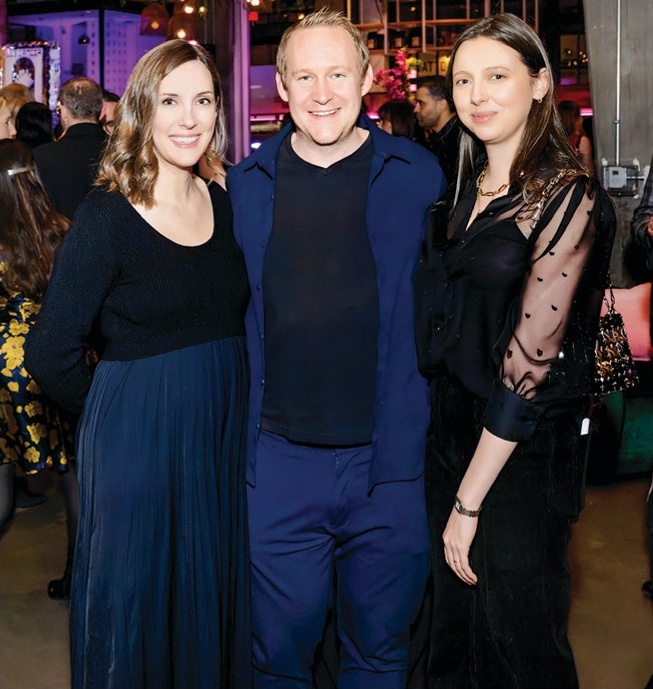
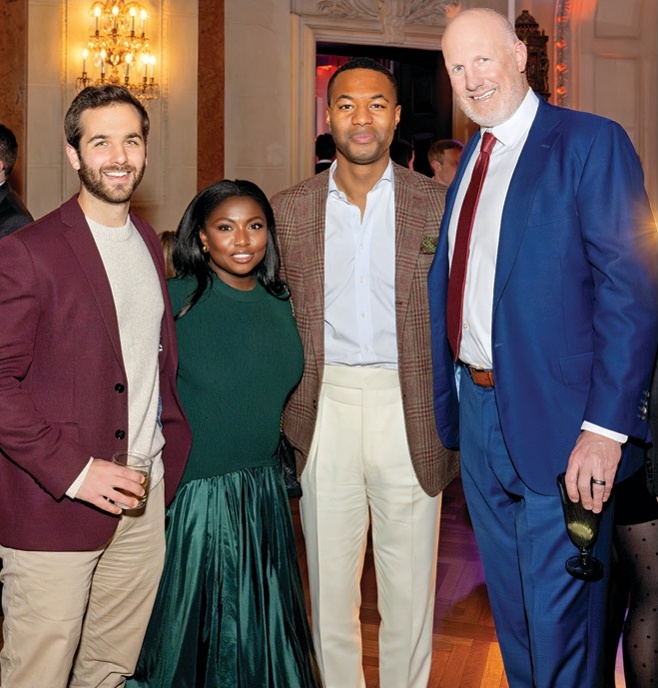
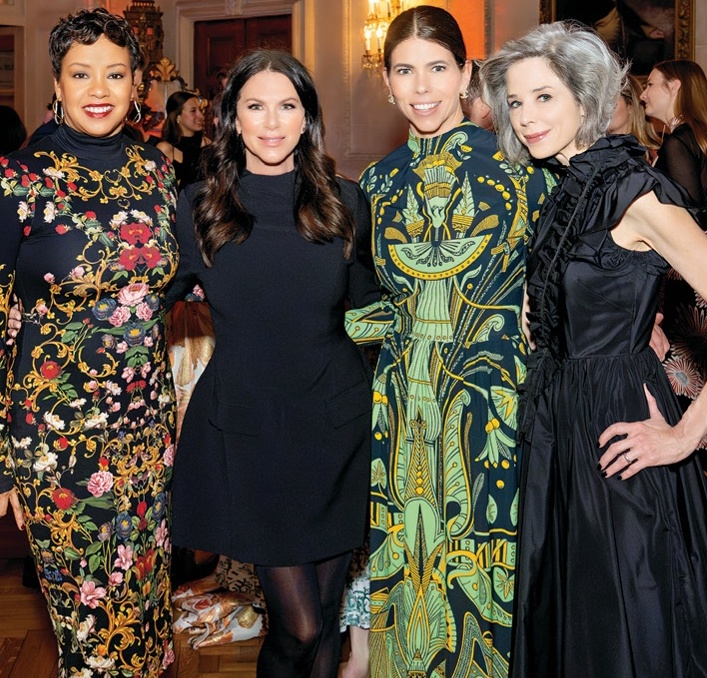
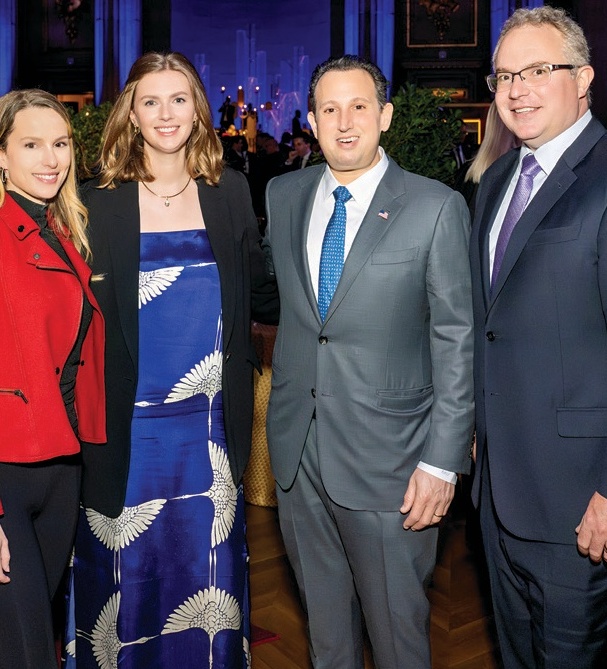
Dan About Town
Party photographer Dan Swartz’s monthly roundup of bashes, balls, and benefits










Our 10 picks for the month in culture













PHOTOGRAPH OF THIBAUDET BY ANDREW ECCLES; PAINTING FROM “OF THE HILLS” COURTESY OF NATIONAL MUSEUM OF ASIAN ART; “ASIAN AMERICAN DANCE JOURNEY” BY STEFAN JENNINGS BATISTA; PHOTOGRAPH OF DANISH STRING QUARTET BY CAROLINE BITTENCOURT; “BICENTENNIAL INDIAN” COURTESY OF NATIONAL GALLERY OF ART, CORCORAN COLLECTION; ALLEN BY NICKY J. SIMS/GETTY IMAGES; HOFFMAN COURTESY OF 9:30 CLUB.





IDEAS. ARGUMENTS. REPORTING.

Reality Check
In an intriguing new novel, former Survivor contestant Stephen Fishbach gives an insider look at how TV competitions actually work
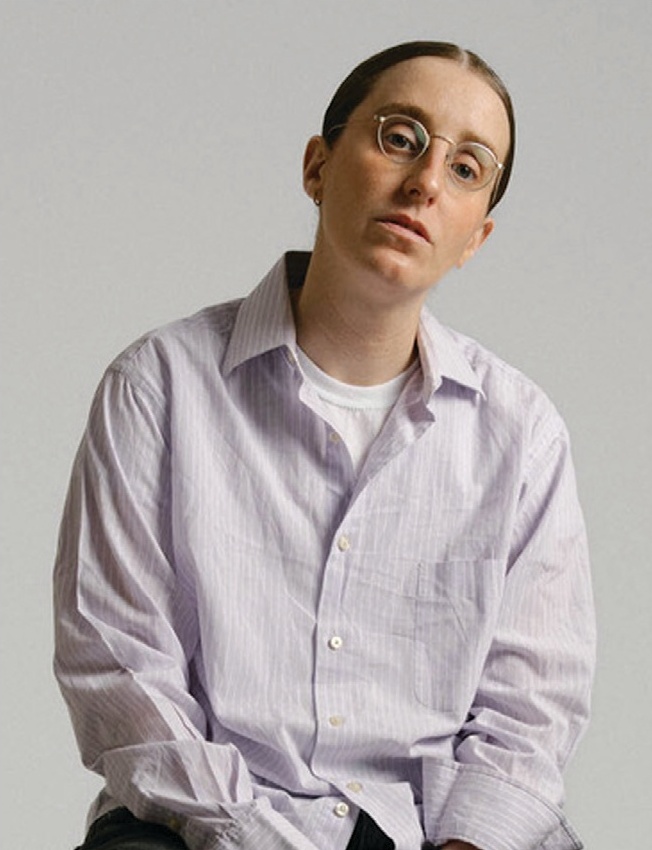
IN HIS DEBUT NOVEL, ESCAPE!, DC author Stephen Fishbach draws on his experience both behind the scenes as a former television executive and as a two-time contestant on the CBS reality show Survivor. The book tells the fictional story of eight contestants trying to get off an isolated island in order to win a million-dollar prize. Escape! is about reality-TV redemption—and who really holds the power once the cameras stop rolling.
Since moving to DC from Los Angeles during the pandemic to be closer to his wife’s family, the Pushcart Prize–winning writer has focused on being known less as a reality-show contestant and more as an author and podcast host. We caught up with him amid his current book tour to talk about writing, the world of Escape!, and life after Survivor.
How did Survivor shape your personal and professional life?
Survivor did two incredible things for me. The first was it opened up my own resilience and capacity as a human being. I lived a very comfortable life working in New York, and Survivor really tested, pushed, and showed me that I could excel beyond what I perceived my own limits to be. That’s how I became a writer—trusting that I could push myself past what I thought I was capable of.
I had this incredible experience on Survivor: Cambodia. There were torrential downpours for days. Everyone was having the worst experience of their lives; everyone was huddled in the shelter, weeping, clinging to each other for warmth, and I got violently ill. I had to strip off my clothes and leave them in the shelter to keep them somewhat dry, go out into the storm, and be violently sick. I had this true epiphany moment of, if I’m willing to do this for Survivor, how can I not do this for the thing I truly care about, which is writing?
I had a similar moment on Survivor: Tocantins, where I made fire for the first time. I didn’t think I was going to be able to. I was on Exile Island all by myself, it was starting to rain, and I knew I was going to be in for the longest night of my life if I couldn’t make fire. I was striking at this flint for hours—literally hours—and then, just as dark was descending, I got a spark. It felt so incredibly empowering that I did it.

CHUTE FOR THE STARS: Fishbach competing on Survivor: Tocantins.
The second thing Survivor did was expose me to people who were dramatically different from me. Everybody lives in bubbles these days, and I certainly did. Most people I knew were like me—not in terms of their ethnicities or backgrounds but in terms of their goals and mindsets, what they wanted out of their lives, how they envisioned a good life for themselves. Survivor is people who are just wildly different, whose expectations from life were hugely different. It broadened my perspective, and that enriched me as a human and therefore enriched me as a writer. Now I have this huge font of characters to draw from.
You mention finding your authenticity and humanity within these very, as you write in the book, manufactured structures. Can you talk more about that?
That’s the core of the novel and the core of what I’m most fascinated by in reality television. Especially for these jungle shows, people really do go out there seeking their deepest, most authentic self and some confrontation with the wild world around them that you don’t really get in our comfortable, safe, urban lives. I absolutely felt that I was finding some deeper part of myself while the cameras were in my face and it was going to be edited to air on CBS prime time.
People think of reality TV as this sort of trashy, disposable thing. There is human depth to the experiences of people on these shows that is so at odds with the cultural imagination of what reality television is. It’s really fascinating.
How has living in DC changed how you think about power, strategy, and competition after Survivor?
Certainly, one of the themes of this book is the way that people use power to manipulate others and impose their will on others. That’s a huge part of our culture now; we see it all around us, the way people flagrantly use power without considering the impact on the human lives around them. That’s the core of the book, and that’s hopefully one way it’s relevant to people outside of the reality-TV fan base—ultimately, this is a book about power and how the more powerful people get to construct the narrative of what’s happening. That’s what we’re facing in our country now.
How often do you get recognized in DC?
More than other places, which is interesting to me. Maybe once a month someone will come up to me, and they’re all wonderful interactions. People say, “Are you Stephen from Survivor?” I say yes, and then we shake hands and occasionally take a picture. It’s always lovely, and I always welcome it. I’m not “real” famous, so I’m not put off by it. I get to feel cool in front of my wife and any friends who happen to be around, so it’s always a real thrill when it happens.
How did you come to write your book?
I’ve always wanted to be a writer, and it was that experience on Survivor: Cambodia that motivated me. When I came back, I said, “I’m going to write a novel.” I was committed to it. Initially, I was writing about a twentysomething in New York, and it just felt like stale terrain that I’d seen before.
I realized I have access to this world—as a former contestant, as someone who worked on the network side, and as someone who worked with reality-TV producers as part of a trade group. I’ve seen the whole scope of this world in a way that I’d never seen depicted in fiction in an authentic way before. I wanted to capture the real human texture of what that’s like.
The book focuses on a contestant named Kent, and also a producer of the show named Beck. Why tell the story through two points of view?
You can’t tell the full reality-TV story without getting both the producer’s and the contestant’s perspective. The contestants are the ones who are experiencing it, and I wanted to add that depth and humanity to them. But, of course, we all know that the producers are putting their thumbs on the scales.
“It was incredible how being on TV changed the way people treated me. Then it goes away. Even more intense than the feeling of celebrity is the low when you lose it.”
What is so fascinating about the producers is the way they are trying to structure the contestants’ lives into a three-act story—how they take these chaotic, messy lives, in the most extreme conditions of the wilderness, and structure them into a narrative. Fundamentally, this is a book about storytelling and narratives and who gets to control the story. The contestants are trying to control their own stories, and producers are trying to control the story of the contestants. I loved that tension. It was really hard to plot. I really wanted to create this tension between these two different worlds.
Why do you have Kent return to reality TV after a very public scandal?
It’s something I’ve seen from former reality contestants who want to escape their real lives and get back to this vision of themselves that they had. Reality shows are filmed for a month; they air for six months. But for a lot of people, they come to define their identities, and then their real life can never measure up to that.
They—we—go to events and kind of perform these cartoonish versions of ourselves, hoping to recapture that feeling for a moment. There is something very sad, but also very contemporary, about that desire to turn yourself into a two-dimensional cartoon and achieve some kind of cultural liftoff. We’re all seeking some fame within our little bubbles, some kind of notoriety, and reality TV feels like a real distilling of this.
And on the other hand, there’s Beck, who needs to redefine herself after a career tragedy. How common are these behind-the-scenes motivations that audiences aren’t clued in on?
That was the thing that was most interesting to me about the producers. The contestants have this view of the producers as these sort of gods. As a contestant, you are putting yourself entirely into the hands of these people. You’re going to a location, you’re doing these challenges, you’re allowing them to lead you blindfolded with this big, holy push—putting your faith in them, that the production edifice is going to take care of you.
But ultimately, they’re just messy, flawed humans who are working through their own tragedies, their own chaotic pasts. That was what I wanted to capture: The person that you want to believe is in control is totally out of control.
In Escape!, you also write about this thing where reality stars have trouble letting go of the spotlight and get pulled back into other reality shows in order to keep it going. Why does that interest you?
It’s such a compelling feeling. Before I went on Survivor, I was not interested in being on TV at all. I thought it was a really cool game, and I wanted an adventure. Then when I got back and it started to air, I noticed people treated me differently. This was literally just the fact of being on television. It wasn’t like I was on Top Chef, where I was demonstrating what an amazing cook I was, or Project Runway. It was incredible how being on TV changed how people treated me. It felt great. Then suddenly it goes away. The show stops airing, and a month later you’re not getting those invitations anymore. Even more intense than the feeling of momentary celebrity is the low when you lose it. You’re constantly scrambling to get it back.
Lastly, would you rather compete in a season of Survivor again or Escape!?
Definitely Survivor. I could not survive in the conditions of Escape! I’d do very badly.
Editorial fellow Tristan Espinoza is at tespinoza@washingtonian.com. This interview has been edited and condensed.
OPENING PHOTOGRAPH BY LAURA METZLER; MONTY BRINTON/CBS VIA GETTY IMAGES




IQ / BOOKS

How Do We Thrive After Trauma?
Psychiatrist Suzan Song put herself in danger to help some of the world’s most wounded people. In a new book, she explains how she and her patients have healed.
WHEN SUZAN SONG WAS GROWING UP IN Ellicott City, her father owned a liquor store that was periodically robbed. In 1993, one of those robberies went sideways. Her father was stabbed multiple times and kidnapped, then saved himself by jumping from a speeding van. He spent months in the hospital. About a year later, he died.
Song was in high school then, and for a long time she believed she was fine—that the violence and grief hadn’t affected her. She went from college to medical school to residency, then to Harvard for a master’s in public health. As she built a career in psychiatry, she was drawn to humanitarian work, seeing patients who had survived torture, sex trafficking, and genocide. She did asylum evaluations for children in US immigration detention and treated the worst-off kids in foster care. Song was obsessed—for no reason that she could discern—with how people handle suffering, and whether they can eventually heal.
Then in 2013, Song was in Burundi researching former child soldiers, studying how trauma reverberates through their adult lives. After an interview, one of her subjects turned on her. He began making threats. Song wasn’t sure what was happening, but her interpreter thought the danger was real. He whisked her to a friend’s apartment and urged her to return to the States.
Hiding in that apartment, Song began asking difficult questions: How did I get here? Why am I doing this? She’d recently been in touch with police about going undercover in the sex-trafficking world, and it struck her that she’d spent an awful lot of her career putting herself in danger. “I was like, wait, why? I’m from suburban Maryland, I don’t need to be doing this,” she told me.
That night, while she was struggling to sleep, Song noticed a large hole in the mosquito netting above her bed and thought of her family’s liquor store—how after one robbery, her dad had installed bulletproof glass in the entryway. The glass hadn’t saved him in the end, and the ripped mosquito netting struck her as the exact same kind of false protection. That was the moment when she connected the dots: All of this was about her dad.
A psychiatric professional like Song might call this a moment of narrative insight, when a person sees that a story they’ve been telling about their life isn’t actually true. In this case, Song suddenly understood that she’d essentially been numb since her dad died. She was locked in a bad pattern of seeking out danger and hardship as a roundabout way of confronting her grief. Her entire professional life—her whole fixation on suffering—was an attempt to answer an urgent personal question: After experiencing trauma, how does one return to feeling alive?
MORE THAN A DECADE LATER, THAT question is at the heart of Song’s first book, Why We Suffer and How We Heal. Published in February, it’s a blend of memoir, patient case studies, and psychological self-help that lays out a framework for surviving suffering. Song and I spoke about it recently at her home in Bethesda, where she maintains a private psychiatric practice, seeing patients from a variety of backgrounds: resettled refugees, tech CEOs, survivors of torture, members of high-profile political families. On her wall were woven injera baskets from Ethiopia. She sat in an armchair drinking herbal tea.
Song began writing her book during the pandemic, she told me, when she was a professor at George Washington University and treating her patients on Zoom. She’d noticed that some were crumbling while others thrived, and the thrivers weren’t necessarily who she expected: They weren’t the best resourced, least traumatized, or most therapized patients, but “they carried themselves with a sense of calm and confidence and mastery,” Song said. “They weren’t avoiding what was going on.” She wondered what they had in common—whether they were born that way or their resilience was an acquired skill.
What they shared, Song concluded, was “the ability to embrace instability.” They understood that life is a cascade of destabilizing events, and they had tools for staying grounded amid strife. She thought a lot about what those tools might be, sifting through her experiences with patients across the globe, and landed on the notion that people thrive by rewriting narratives, performing rituals, and embracing a greater purpose. These became the three sections of her book.
The narrative aspect, Song told me, is very Western. “Americans are so obsessed with our thoughts,” she said, explaining that in the United States, healing is often understood to begin and end with learning to tell different stories about ourselves. She finds that important, but she writes that “insight alone doesn’t always change behavior.” Self-examination “can trap you in an insular world of unproductive ruminations, like tumbling through a dryer cycle that never stops.”

FAMILY TIME: Song and her dad, who died after being stabbed in a robbery.
That’s where ritual and purpose come in. In cultures with no therapists or psychiatrists, Song explained, people “don’t sit around talking to a stranger about their deepest, darkest thoughts.” They may not ever discuss their trauma with anyone at all. In those contexts, Song realized, healing tends not to involve connecting a person more deeply to themselves; it’s about connecting a traumatized person with community and making them feel like they belong.
Rituals, like funerals or baptisms, are often collective affairs, embedding people in their communities during times of transition or pain. And finding purpose is the cornerstone of a meaningful life; Song writes that “when purpose is missing, success feels empty and struggle feels like you’re just getting by.” A person with purpose believes that they matter in the world, and Song thinks that people mostly feel that way when helping others.
For a long time, Song’s humanitarian work seemed like purpose; ostensibly, she was helping people heal. But throughout her early career, she mostly felt numb and robotic. Her work shut down her interior life. “Especially working with torture survivors,” she told me, “I could put all of my energy into them, so I didn’t have to think about myself.” Now she understands that making herself a witness to trauma prevented her from seeing herself as a victim of it. And as long as she was alienated from herself, she couldn’t heal.
AFTER SONG’S TRANSFORMATIVE MOMENT in Burundi, when she realized that her whole career had been a reaction to her dad, she returned to the United States and stopped working abroad. She thought she was done with it forever. Being in conflict settings had required her to dissociate in order to function, to repress her emotions and fears. She’d been in that mode for decades. To recover, she began trying to reconnect with herself—probing her false narratives, making “micro-changes” in her life to see what felt good. In figuring out who she was and what she wanted, she had to restore the sense of safety and joy that she’d lost after her father’s death.
When Song allowed herself to stop numbing, a surprising feeling arose: She missed being with people at their most vulnerable moments. In doing humanitarian work, she would have “these little doses of intimacy” with people. It made her feel more human. While she no longer felt blindly compelled to encounter suffering, she realized that she actually still wanted to—not to untangle her own trauma, but to do good in the world. In 2014, when she heard a radio story about chemical warfare in Syria, she reached out to a friend at UNICEF. Two weeks later, she was in a refugee camp on the Syrian border, consulting on how to help migrant teens.
Song had returned to humanitarian work, but it felt different this time around. For one, her interactions with people felt more present and human. “Until then, I had been so disconnected from myself that I was somewhat disconnected from the people I was working with,” she explained. And she was also thinking less like a clinician, whose job is to help individual people heal, and focusing more on systems. She wanted to help whole populations of people by changing the environments and policies that cause suffering in the first place.
Americans assume that we need to figure things out by ourselves. “But we’re supposed to be in this together,” Song says.
These days, Song frequently consults on global humanitarian issues. She has recently built school-based mental-health programs in Ethiopia and assembled teams to help kids in Ukraine. She has advised the United Nations, the International Medical Corps, the State Department, and the US Office for Victims of Crime. In a way, writing Why We Suffer and How We Heal is a hybrid of her clinical and consulting work, taking the insights that she provides to her individual patients and dispensing them at scale.
When I asked what the primary takeaway from her book should be, Song said that “people aren’t meant to do life alone.” She herself is a member of four different book clubs (it’s purely social; she doesn’t read the books), and sometimes, for fun, she and her kids bake cookies and drop them off in the neighborhood door to door. This winter, she hosted a Lunar New Year party for her older neighbors because she was worried about them being cooped up with all the ice.
Working in other countries, Song told me, “you can feel the fabric in the air that stitches people together, but every time I fly back to the US, I feel the isolation. You land, and then you realize, ‘Oh, I’m all alone.’ ” To Song, so much suffering occurs simply because Americans assume that we need to figure things out by ourselves. “But we’re supposed to be dependent on each other,” she said. “We’re supposed to be messy, and we’re supposed to be in this together.”
In a way, Song’s whole job is to make suffering less lonely: to be a moral witness to pain, to sit with the aftershocks of some of the worst human-rights abuses on the planet. I asked how she makes sense of it. “I am not Pollyanna-ish, like, ‘There is a silver lining to everything,’ because there is not,” she told me. “Sometimes it’s just unfair.” But she believes that many of her patients simply need someone to hear their suffering and tell them that what happened to them was wrong. She brought up the child psychoanalyst Selma Fraiberg, who once observed that a mother can’t hear her child’s cries until someone has heard her own. “I think that’s actually applicable to all of us,” Song said. “We are all just a bunch of wounded people bumping into each other, and our goal is to not hurt each other as best as we can.”
PHOTOGRAPHS: SUSAN LEBOWITZ PHOTOGRAPHY; COURTESY OF SUZAN SONG























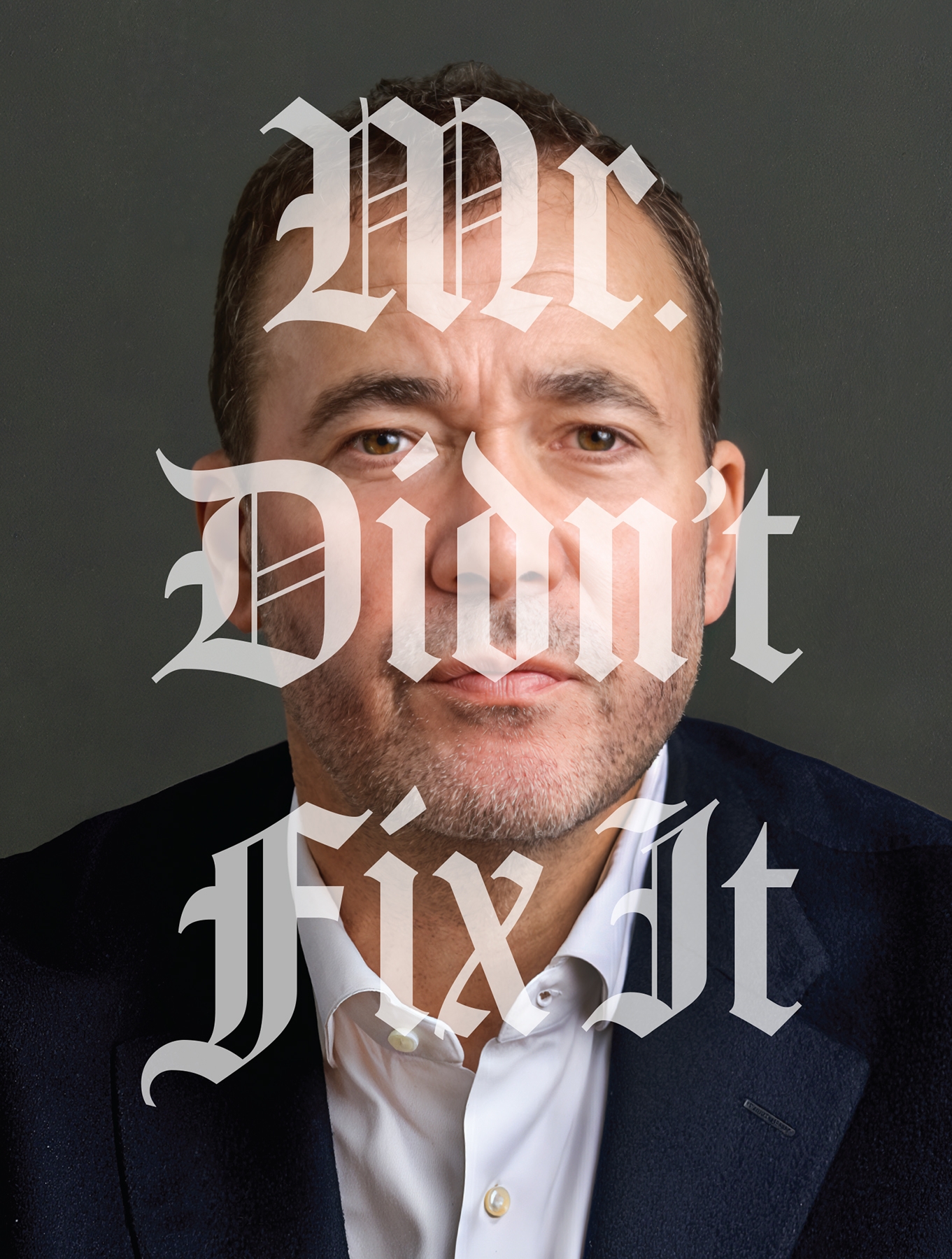
Two years ago, Jeff Bezos brought in controversial media executive Will Lewis to lift the Washington Post out of a post-Trump slump. His calamitous tenure ended in failure—and has left the storied newspaper in an even deeper hole.
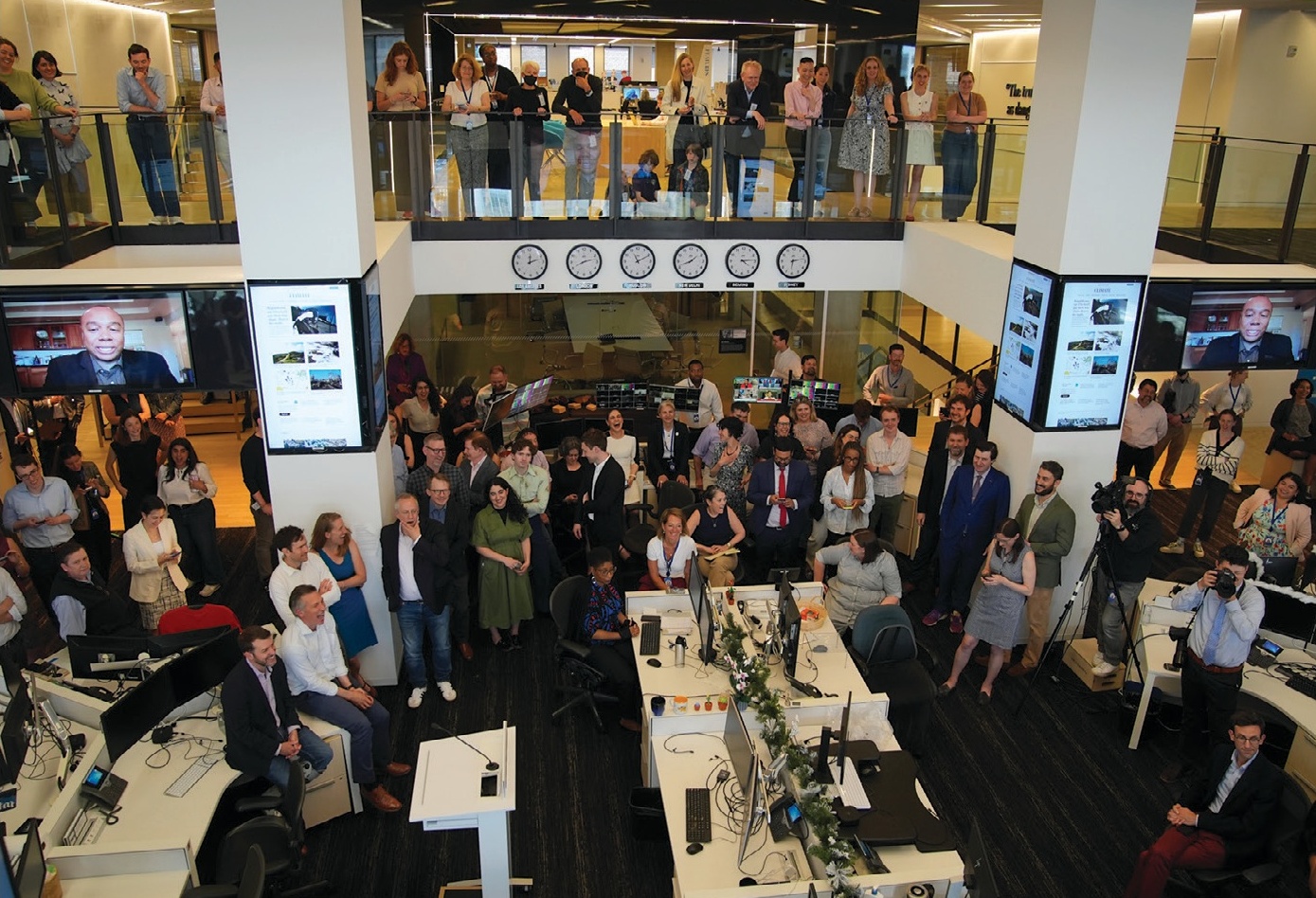
W hen the bad news broke, Will Lewis wasn’t around for it. As hundreds of Washington Post employees gathered in front of phones and laptops for a Zoom meeting in early February to learn their fates, the Post’s chief executive and publisher didn’t appear on their screens. Instead, the announcement that more than 350 journalists would lose their jobs was left to executive editor Matt Murray. Afterward, Lewis made no statements and granted no interviews. Murray said later that Lewis “had a lot of things to tend to today.”
The mass layoff—amounting to nearly half of the Post’s vaunted newsroom—translated into a broad disfiguring of the publication. The paper vaporized its sports and book sections, halved its network of foreign bureaus, and reduced its Metro section—where its history-making Watergate coverage had begun—to a skeleton. Every staff photographer was laid off. Among the casualties was Martin Weil, a beloved Metro reporter who’d worked at the paper since Lyndon Johnson was President. Weil was notified in a form letter delivered via email.
Past and present Post employees trained their anger and disappointment on the paper’s owner, Jeff Bezos, Amazon’s multi-billionaire founder. Former executive editor Martin Baron blasted the world’s fifth-richest man for neglect, abandonment, and worse. Some of Bezos’s decisions, Baron wrote, were “gutless” and reflected “moral infirmity.” The paper had been losing money for several years, yes, but critics argued that Bezos could afford to lose money—literally for centuries—to maintain the paper’s newsgathering. He was now worth around $250 billion, ten times as much as he was when he bought the Post in 2013. Back then, he promised to provide “runway” (read: hard cash) for growth and experimentation. The new cuts would instead make the paper’s newsroom smaller than when Bezos first stepped in—smaller even than Politico, cofounded in 2007 by two former Post reporters.
Lewis received his share of the rage and blame, too. Hired by Bezos in early 2024 to reverse declining readership and revenues, the 56-year-old newsman turned media executive had plainly failed. The Post lost a reported $100 million in 2024, Lewis’s first year, and even more in 2025. Lewis was unable to stanch the bleeding, despite previous buyouts and layoffs. Dozens more star journalists had left on their own, disappointed and disgusted by what they saw as his fecklessness.
Only a few months into his tenure, Lewis had retreated into a kind of sullen isolation. When Post reporters landed important scoops—such as the revelation in late November 2025 of the Pentagon’s “double tap” strike on a suspected drug-smuggling boat—he couldn’t muster up an attaboy or use it as a peg for collective encouragement, a tradition for the paper’s publishers. For a brief period, Lewis had even stopped talking to Murray, whom he’d handpicked to lead the news operation. “As far as the newsroom is concerned, he’s a nonentity,” a veteran reporter said in early January. “We haven’t seen him in months. He’s a ghost.”

Lewis, who hasn’t given an on-the-record interview in more than two years, didn’t respond to multiple requests for comment on this article. Nor did Murray or three of Lewis’s top business deputies. A Post spokesperson offered limited information in response to submitted questions.
The day after the Post’s bloodletting, Lewis was photographed—by a former Post sportswriter—walking the red carpet at a pre–Super Bowl event in San Francisco. More outrage ensued. Two days later, he was gone for good, announcing his departure in a terse email. Few mourned. “I’m glad Will Lewis has been fired,” Post reporter Katie Mettler told the New York Times. “I wish it had happened before he fired all my friends.”
Before Lewis left, newsroom morale had fallen so low that journalists had adopted a kind of rallying cry on an internal Slack channel: “Outlast the fuckery!” In the wake of his calamitous tenure, however, something one reporter had told Washingtonian in late January now sounded prophetic: “Looks like the fuckery is going to win after all.”
Broken Trust
Lewis arrived at the Post on a small wave of optimism and expectation. During his first meeting with staffers, in November 2023, he laid out his credentials, noting that he’d been a reporter and editor for 20 years before moving to the business side. He encouraged attendees to ask him hard questions and promised to “never buckle” when defending journalists. “We will always get the story done,” he declared. As a badge of his independence and integrity, he mentioned he’d been publisher of the Wall Street Journal in 2015 during its investigation of Theranos, a fraudulent medical startup that had received $125 million of investment from Journal principal owner Rupert Murdoch.
Lewis struck many as affable, witty, and energetic, as one might have expected of a man who’d captained his British university’s soccer team. The newsletter Semafor, in an early assessment, described him as “a relentlessly charming Brit whose uniform is sleek sweaters and expensive-looking sneakers.” Bezos paid his transatlantic hand handsomely: $3 million a year, according to records uncovered by former Post columnist Gene Weingarten.
Lewis was a dramatic change from his genteel predecessor, Fred Ryan, a former top staffer for President Reagan and Politico’s first president and CEO. Hired by Bezos in 2014, Ryan had overseen a period of increased readership and profitability during President Trump’s relentlessly newsmaking first term. But as that “Trump bump” turned into a broader media slump in 2021, Ryan seemed frozen, unable to adapt to a changing landscape of burned-out audiences and relative calm in the White House. Monthly visitors to the Post’s website plummeted from a pandemic-driven peak of 139 million in March 2020 to 58 million in December 2022. Digital subscriptions, which had grown to nearly 3 million by 2020, fell by nearly 500,000 as a sense of national crisis abated. When Ryan announced pending layoffs during a late-2022 town-hall meeting—and then walked away without taking questions—staffers were apoplectic. The next summer, he left the Post. The paper reportedly lost a total of $177 million in 2022 and 2023.
Bezos thought Lewis had the chops to turn things around. Born into a family of overachievers—his father and older brother had both received royal honors—Lewis began his career as a business reporter at the Mail on Sunday tabloid in 1991, advancing quickly to the more prestigious Financial Times, which sent him to New York in 1998 to cover Wall Street. A colleague from this period remembers Lewis as a driven reporter who developed an extensive network of sources, often courting them after hours: “He was out every night drinking with bankers. He was a charismatic force in the newsroom, very funny, fearless, and bold. He’d come in in the morning, shirttails out, pulling bar napkins with notes on them out of his pockets, and announce, ‘I’ve got a cracker here!’ ”
One of those crackers was a landmark scoop: news of a merger between Exxon and Mobil, then the largest industrial deal in history. Lewis soon began what a profile once described as a “vertiginous” rise through British media. After a stint as an editor at London’s Sunday Times, he joined the Daily Telegraph in 2005 as city editor. Just over a year later, he was promoted to editor in chief, at 37 the youngest in the newspaper’s 151-year history.
In early 2009, Lewis took a daring step, urging the Telegraph’s owners to pay an anonymous government whistleblower for an explosive piece of information—a secret database of files detailing lavish personal spending by members of Parliament and the prime minister’s cabinet, all at taxpayer expense. Paying for scoops isn’t uncommon for British tabloids, but it’s rare for more prestigious publications like the Telegraph. The paper ultimately spent about $165,000 on the files. Led by Lewis and a top reporter, Robert Winnett, the Telegraph mined the data for a series of bombshells. The reporting triggered national outrage and led to the resignations of dozens of officials. Seven more went to prison. Lewis was the toast of the British media, named “journalist of the year” at the 2010 British Press Awards.
“Will embodies the tenacity, energy and vision needed for this role,” Bezos wrote in an email to Post staff in late 2023 announcing Lewis’s hiring.
Lewis also attempted to push the Telegraph further into digital-news delivery by starting something called the Euston Project, a $15 million, 50-person effort to develop new online revenues. During his run as publisher of the Wall Street Journal from 2014 to 2020, the paper added some 700,000 new subscribers, expanding to more than 2 million in total. Bezos was impressed. “Will embodies the tenacity, energy and vision needed for this role,” he wrote in an email to Post staff in late 2023 announcing his hiring. “He believes that together we will build the right future for the Post. I agree.”
Arriving in Washington, Lewis settled into a $7 million house in Georgetown and began a “listening tour.” He initially was a gregarious presence in the Post’s newsroom, roaming among the cubicles and booming out praise (“Great story!”). He was visible outside the paper, too. Lewis traveled Washington’s social circuit guided by Sally Quinn, the longtime Post writer and widow of legendary editor Ben Bradlee. At one party, Quinn introduced him to Chuck Schumer, the Senate minority leader. “Just don’t forget,” Schumer told Lewis with a smile, “I’m a big fucking deal around here!”
Within months, however, a bitter chill set in at the Post, rooted in a murky chapter of Lewis’s career. In 2010, Lewis left the Telegraph for a management job at News International, the British newspaper company controlled by Murdoch. The company soon became engulfed in a sprawling scandal in which its journalists were suspected of prying into the voicemails and emails of celebrities, politicians, and others in search of news. Assigned to clean up the mess, Lewis acted as a liaison between the company and criminal investigators.
Hacking victims—including Prince Harry and former prime minister Gordon Brown—later accused Lewis of covering up potentially incriminating evidence, specifically by overseeing the deletion of millions of company emails. Lewis has long denied wrongdoing and has never been charged with a crime, but the allegations remain under active investigation by Scotland Yard.
It’s unclear how the Post’s recruiters characterized all of this when they recommended Lewis as a candidate to replace Ryan. But it’s impossible to argue they were unaware. After his triumph on the expenses scandal, Lewis became a pariah among many British journalists for his “cleanup” work: Many suspected he’d steered investigators toward reporters and low-ranking editors, protecting Murdoch and his top executives. The even more damning claim—that Lewis had actively engaged in hiding evidence—formally surfaced in a lawsuit filed by more than 50 hacking victims in 2020 and was raised anew in lawsuits by Prince Harry and actor Hugh Grant in 2023. (Both later settled.)
The Post’s own investigative reporting on Lewis’s past role in cleaning up a sprawling hacking scandal “raised serious questions about Will’s judgment and ethics.”
Just before Lewis joined the Post, NPR reporter David Folkenflik approached Lewis for an interview. Lewis offered him an exclusive, on the condition that he not mention the hacking scandal. Folkenflik declined, wrote about the allegations, and later revealed Lewis’s offer. In response, Lewis called him an “activist, not a journalist.” When then–Post executive editor Sally Buzbee told Lewis in early 2024 that the paper intended to dig into the hacking story, the new publisher twice discouraged her. She launched the inquiry anyway, placing a senior editor, Matea Gold, in charge of a team that grew to eight reporters and other editors. They produced a series of stories that the Post boldly displayed on its front page. One of them revealed that Lewis and Winnett, his protégé at the Telegraph, had published articles years earlier based on information obtained through unsavory and possibly illegal means. The reporting, says a journalist who was involved in the Post’s investigation, “raised serious questions about Will’s judgment and ethics.” His attempts to suppress the story “violated a fundamental principle that news organizations must guard against conflicts of interest.”
Bezos stood by Lewis. But whatever trust the Post newsroom still had in the publisher vanished when Lewis sought to demote Buzbee as part of a proposed reorganization in mid-2024. She chose to resign instead, and Lewis tapped Winnett to replace her. The situation came to a head at a contentious staff meeting the day after Lewis announced Buzbee’s departure in a Sunday-night email. Peppered with skeptical questions, Lewis grew defensive, then churlish. When reporter Carol Leonnig, a multiple Pulitzer Prize winner, asked him about his “vision” for the paper, Lewis snapped at her: “We are going to turn this around, but let’s not sugarcoat it. It needs turning around,” adding, “People are not reading your stuff.”
The meeting was brief, and ended by Lewis. Winnett didn’t last long, either: The Post’s reporting prompted him to withdraw as top editor before he started the job.
Building Vaporware
Early in his tenure, Lewis summed up his strategy for reviving the Post with a mantra worthy of a Silicon Valley pitch deck: “Fix it, build it, scale it.” The motto had an appealing simplicity—and if Lewis had made good on any of those fronts, he might have mended his fractured relationship with the newsroom.
Only that’s not what happened. Lewis first promised to find more readers and subscribers via acquisitions, mimicking the New York Times’s successful strategy of buying Wordle, Wirecutter, and the Athletic. But outside of a brief, tire-kicking session with the owners of the Punchbowl political newsletter in 2024, the Post and Lewis never made any deals.
At the same time Lewis announced Buzbee’s departure, he proposed creating a “third newsroom”—a new entity on par with the paper’s news and opinion sections but centered on youth-centric news videos, lifestyle articles, and social-media-friendly posts. The idea echoed not one but two of Lewis’s old ideas: the Euston Project of 2009 and the News Movement, a British company he founded in 2020. Like the Euston Project, the Post’s “third newsroom”—renamed WP Ventures—was supposed to be, among other things, a laboratory for experimentation and innovation. A respected newsroom veteran, managing editor Krissah Thompson, and an experienced manager, Samantha Henig, were named to run it. The Post’s social-media, video, audio, newsletter, and health-reporting staffs were nominally assigned to the project, though people on those teams were expected to continue their daily responsibilities. Top management also decreed that the project would have to make do with existing resources—no new hires were anticipated.
Progress was halting. Ideas came and went—mostly the latter, according to people who were involved. Among the proposals that never made it off the drawing board: “expanded” horoscope listings, with in-depth details for every sign. Nothing out of WP Ventures produced meaningful new revenue. In July 2025—eight months after Murray formally announced the initiative and after thousands of man-hours of development—Thompson took a buyout. By the time Henig left the paper in October, WP Ventures had effectively collapsed. Lewis’s big idea was, in Silicon Valley–speak, vaporware. It mirrored the Euston Project, which closed less than a year after Lewis started it. “No one was ever sure what the third newsroom was going to be,” says a veteran reporter and editor who left during Lewis’s tenure. “It turned out to be nothing.”

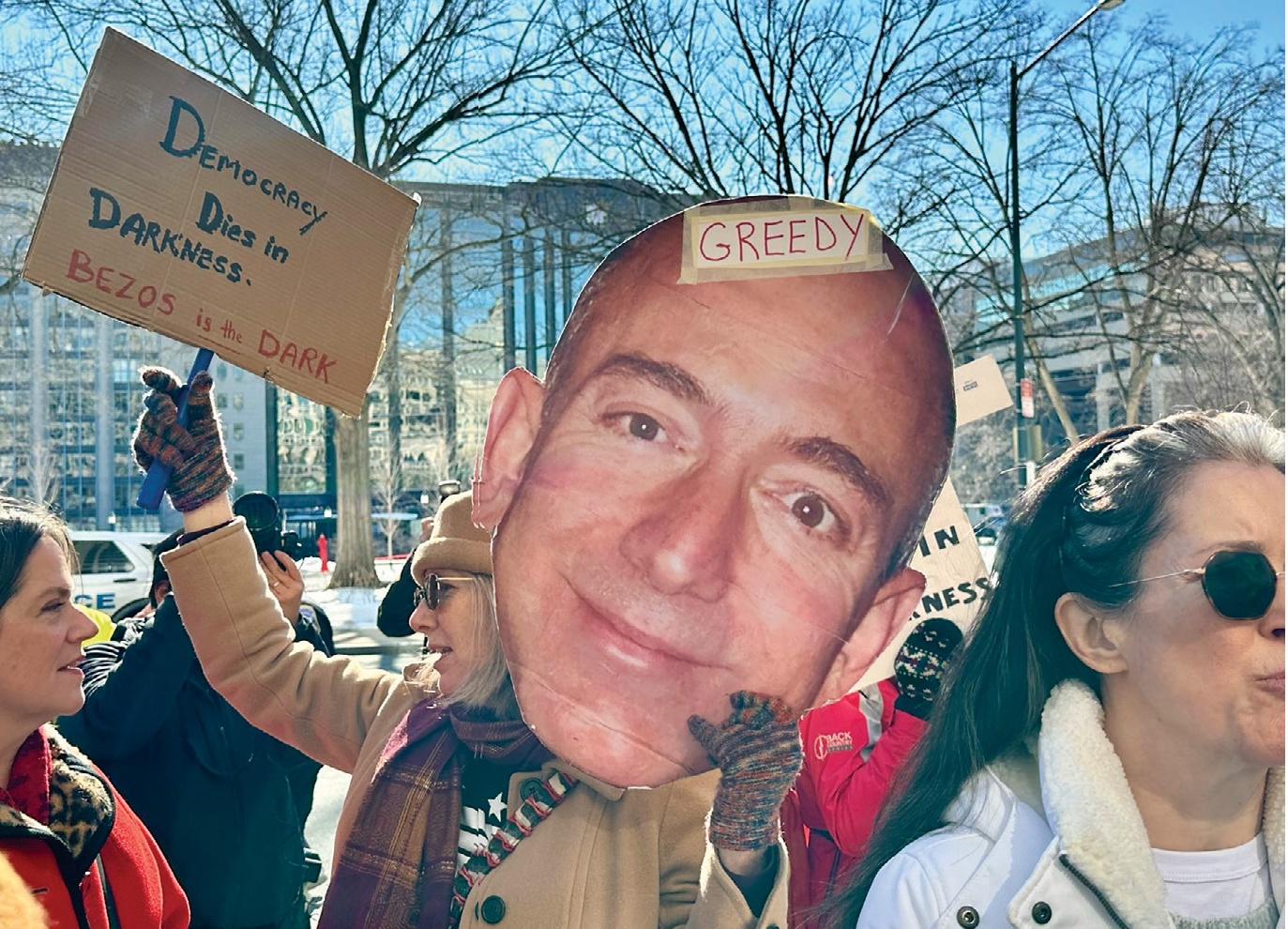
Lewis’s would-be innovation efforts were doctored by a succession of British consultants, whom some in the newsroom referred to as “Will’s shadow team of Brits,” or simply “the blokes.” He also favored outsiders for senior positions: Of the 21 names on the Post’s masthead—its top business and news managers—at the start of this year, eight were British natives and/or people Lewis had previously worked with at Dow Jones and the Journal. “We heard a lot of British accents,” says a former editor and reporter, “and we wondered, ‘Who are these people? What do they know about the Post or Washington or even America?’ ”
Bezos, meanwhile, remained a remote figure who hadn’t visited the Post since early 2023. He did encourage the paper to think bigger and target people who had never considered subscribing. In response, management produced a PowerPoint presentation in early 2025 that included a “Big Hairy Audacious Goal” of reaching at least 200 million paying users—roughly 80 times its then–subscriber base—including “firefighters in Cleveland.” One person who saw the presentation tells Washingtonian it helped convince them to leave the Post: “My thought was that Lewis and Bezos didn’t know anything about firefighters in Cleveland or anywhere else.”
Vanishing Act
For all of Lewis’s misfires, it was Bezos who made arguably the two most injurious decisions during his tenure. The first came in October 2024, 11 days before the election, when Bezos decreed that the paper would end its practice of endorsing presidential candidates. Readers interpreted the move as a sop to Trump—the Post had planned to endorse Kamala Harris—and made their disappointment and anger known. Within ten days, some 250,000 people had canceled their subscriptions.
Lewis was initially the face of the fiasco, writing in a Post editorial that the decision was “a statement of support of our readers’ ability to make up their own minds.” But Bezos acknowledged a few days later that he’d made the call, writing that endorsements merely added to the public’s perception of media bias.
A few months later, Bezos announced that the Post would no longer offer a variety of opinions on its editorial page and instead would write only in defense of “personal liberties and free markets.” The decision, which struck many as another move to the right, led to the section editor’s resignation and a second cancellation frenzy that sheered another 100,000 subscribers off the books.
If ever there was a time for Lewis to stand up for his staff—to make good on his early promise to “never buckle”—this was it. There’s no indication he did. Instead, he receded further into ghost mode. In 2024, when the Post won three Pulitzer Prizes, Lewis didn’t show up to lead the newsroom celebration, the publisher’s traditional role. He was also missing last March when Warren Buffett hosted a screening of a documentary about legendary Post publisher Katharine Graham at the Kennedy Center. When he failed to show for another Pulitzer celebration again in 2025, Murray wanly explained that Lewis was traveling and would congratulate the winners on his return. Post journalists rolled their eyes—some likened it to a child being told that his perpetually absentee father would surely visit on their next birthday.
One of the events Lewis did preside over was a lavish brunch reception at the exclusive Ned’s Club following the White House Correspondents’ Dinner last spring. The party, which featured generous displays of caviar and a guest list of Washington insiders, cost $1 million, according to the New York Times. Reporters were livid. One noted that the sum represented “a not-insignificant” fraction of the Post’s losses for the year.
A few months earlier, more than 400 newsroom employees had signed an extraordinary letter to Bezos saying they were “deeply alarmed” by the Post’s growing problems. They urged him to come to the office and meet with employees. He never did. As the outrages and disappointments piled up, dozens of Post journalists left for jobs elsewhere. So many landed at the New York Times that the joke inside the Post was that the Times’s Washington bureau had become Lewis’s “third newsroom.”
The mood darkening, reporters began to gossip about whether Lewis’s fondness for after-hours drinking had affected his leadership. The satirical British magazine Private Eye had once nicknamed Lewis “Thirsty,” in reference to his frequent pub appearances. One former Post reporter told Washingtonian about an after-hours episode at a company-sponsored advertiser conference in Florida in 2024: Amid rounds of cocktails, Lewis made an embarrassing remark in front of clients. Several described an encounter between Lewis and the Post’s lobby security staff in which the new publisher talked about his hangover. Four former Post reporters told Washingtonian they brought up Lewis’s drinking in exit interviews with the company’s human-resources managers. One expressed concern that Lewis might embarrass the Post in public settings; another wondered if his “disheveled and hungover” appearance had a negative impact on business dealings. “It was clear to me that this wasn’t news” to the HR interviewer, one said. (The Post didn’t respond to direct inquiries about this topic.)
“As far as the newsroom is concerned, he’s a nonentity,” a Post reporter said of Lewis shortly before his departure. “We haven’t seen him in months. He’s a ghost.”
Another question puzzled the newsroom: Why did Bezos, surely as savvy a businessman as any alive, stick with Lewis for so long? People who know Lewis note that his career has advanced with the trust and approval of powerful men—Bezos, Murdoch, and Boris Johnson. The former London mayor and British prime minister, Johnson was a longtime correspondent and columnist for the Telegraph and an old colleague and friend of Lewis’s. Lewis served as one of Johnson’s political consultants after leaving the Journal in 2020, advising him in the aftermath of “Partygate,” a scandal involving social events held at 10 Downing Street while Britain was under strict pandemic lock-down orders. Johnson rewarded Lewis’s loyalty by submitting his name for a knighthood in honor of “political and public service” in 2022. Glenn Kessler, who wrote the Post’s Fact Checker column, says that Lewis—now officially Sir William—“is really good at managing up.” As for Bezos’s loyalty to him in the face of enduring failure, Kessler speculates: “No one wants to admit he made a mistake, especially a billionaire.”
It’s not clear whether Bezos pushed Lewis out or if he jumped ship of his own accord. But it’s apparent that the Post owner wasn’t sentimental about his departure. In a brief memo to staff, Bezos praised the paper’s continuing leadership and signaled “an exciting and thriving next chapter.” He didn’t mention Lewis at all.
Paying the Price
By almost every measure, Lewis left a legacy of ashes. The Post continues to produce important work, ranging from pieces on DOGE’s decimation of the federal workforce to coverage of Trump’s mauling of the Kennedy Center. But its stature and reach are in decline.
Among current and former employees, there’s a somewhat surprising theory: that Bezos isn’t actually displeased by the paper’s travails. In the treacherous, retaliatory atmosphere of Trump’s second term, a smaller, weaker, and less troublesome Post might pose fewer risks to the more prosperous parts of Bezos’s business empire—particularly Amazon and Blue Origin, his rocket company.
During Trump’s first term, the President periodically lashed out at Bezos and the Post, accusing the paper of being “the Amazon Washington Post.” Bezos is keenly aware that Trump’s hostility jeopardized Amazon’s delivery deals with the US Postal Service and complicated the company’s pursuit of a $10 billion Pentagon cloud-computing contract. (Amazon lost its bid for the project in 2019 but later sued, alleging Trump had applied “improper pressure” to influence the outcome. The project eventually was scrapped, and Amazon became one of four contractors on a revised contract.) Today Bezos also has to keep up with Elon Musk—owner of the spaceflight competitor SpaceX—who contributed nearly $300 million to Republican candidates, including Trump, in the 2024 election.
It’s not hard to squint and see the many pieces of a puzzle falling into place: Bezos’s spiking of the Post’s Harris endorsement; Amazon’s $1 million contribution to Trump’s inaugural committee; Bezos’s attendance at Trump’s inauguration; his abrupt decision to transform the Post’s opinion section into a more Trump-friendly environment; Amazon’s purchase of reruns of Trump’s The Apprentice reality show and its investment of $75 million in a Melania Trump–produced documentary; Amazon’s contribution to Trump’s White House ballroom project. Is it mere coincidence that Trump has refrained from criticizing Bezos, Amazon, and the Post in his second term, remaining silent even as the paper underwent its convulsive contraction in February? Possibly not.
“[Bezos’s] goal for the Post is to lose less money and for it to be something that isn’t a huge headache for his other businesses,” a former editor at the paper says. “Losing 250,000 subscribers is the price you pay for not antagonizing Trump. Amazon is the source of his wealth, Blue Origin is his passion. The Post is neither. On some level, I don’t blame him” for kowtowing to the President.
It took decades to build the Post into a jewel of journalism, a small but vital cog in the machinery of democracy. When Bezos bought the paper, he seemed to take that role seriously—until it became too costly, and perhaps too inconvenient. Lewis did little to change his mind. “If there’s an obit of the Post someday, the history books will say [Lewis] was the last captain on deck when the ship hit the iceberg,” says Kessler, who worked at the paper for 27 years. “But the ship was already headed toward the iceberg. Lewis just made the course worse.”
Paul Farhi covered the news media and other topics during 35 years as a Washington Post reporter. He’s been a freelance reporter since 2024.
PHOTOGRAPH ON OPENING PAGE BY ELLIOTT O’DONOVAN FOR WASHINGTON POST VIA GETTY IMAGES; MARVIN JOSEPH/ WASHINGTON POST VIA GETTY IMAGES; EVY MAGES; JAHI CHIKWENDIU/ WASHINGTON POST VIA GETTY IMAGES



MAKING THE SALE
For more than a decade, the Washington area’s residential real-estate market has favored sellers, sometimes dramatically. But that’s changing.
Last year’s federal layoffs and extended government shutdown dampened buyer confidence. In the beginning of this year, home sales were down, active listings were up, and there were more available properties than interested buyers. Though the median home price in the region continued to climb, some properties were sitting longer—leaving sellers to come down in price or pull them off the market altogether. Meanwhile, some federal workers and contractors who lost their jobs but have been trying to stay in the area may finally need to sell, potentially softening the market further.
As buyers enjoy newfound leverage, agents and sellers are having to find creative ways to promote their properties and stand out from the competition. And that’s true in every corner of the market. It can mean losing the silver paint and mirrored ceilings in the opulent ballroom of a multimillion-dollar McLean mansion; emphasizing the pet-friendliness of a particular condominium building; using artificial intelligence to virtually stage a vacant property a half dozen different ways; or changing the address of a home saddled with a heinous history.
Of course, there’s no one simple trick to making a property move. Sometimes, it’s enough to add some plants and repaint the front door—other times, it helps to serve margaritas while synchronized swimmers perform in the pool at your open house. Ultimately, though, the goal remains the same: closing the deal, regardless of the bigger picture. Here’s how some locals are getting it done.
THE $100,000 MAKEOVER
When an $18.5 million mansion in McLean wasn’t moving, the seller reimagined it—and covered up the gold paint
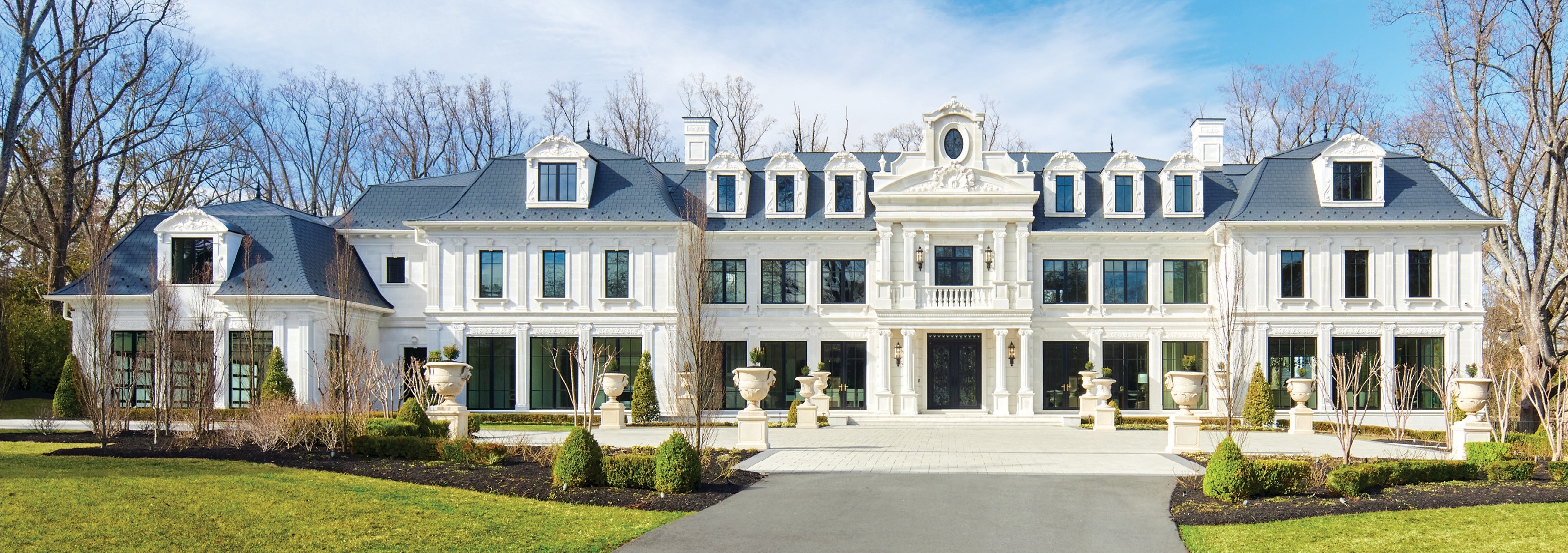
Stately homes designed in 18th-century French architectural style—the kinds of places where the Earl of Grantham or Mrs. Astor might be comfortable—are not unusual in the Langley Farms section of McLean. But when a palatial 22,000-square-foot house on Georgetown Pike, built on nearly four acres in 2023, lingered on the market, the Building Group brought in Will Thomas for consultation.
“They have a great track record of building and selling really large homes in McLean, and they built this one, which they called Chateau du Soleil, with a specific buyer profile in mind,” says Thomas, an agent with TTR Sotheby’s International Realty.
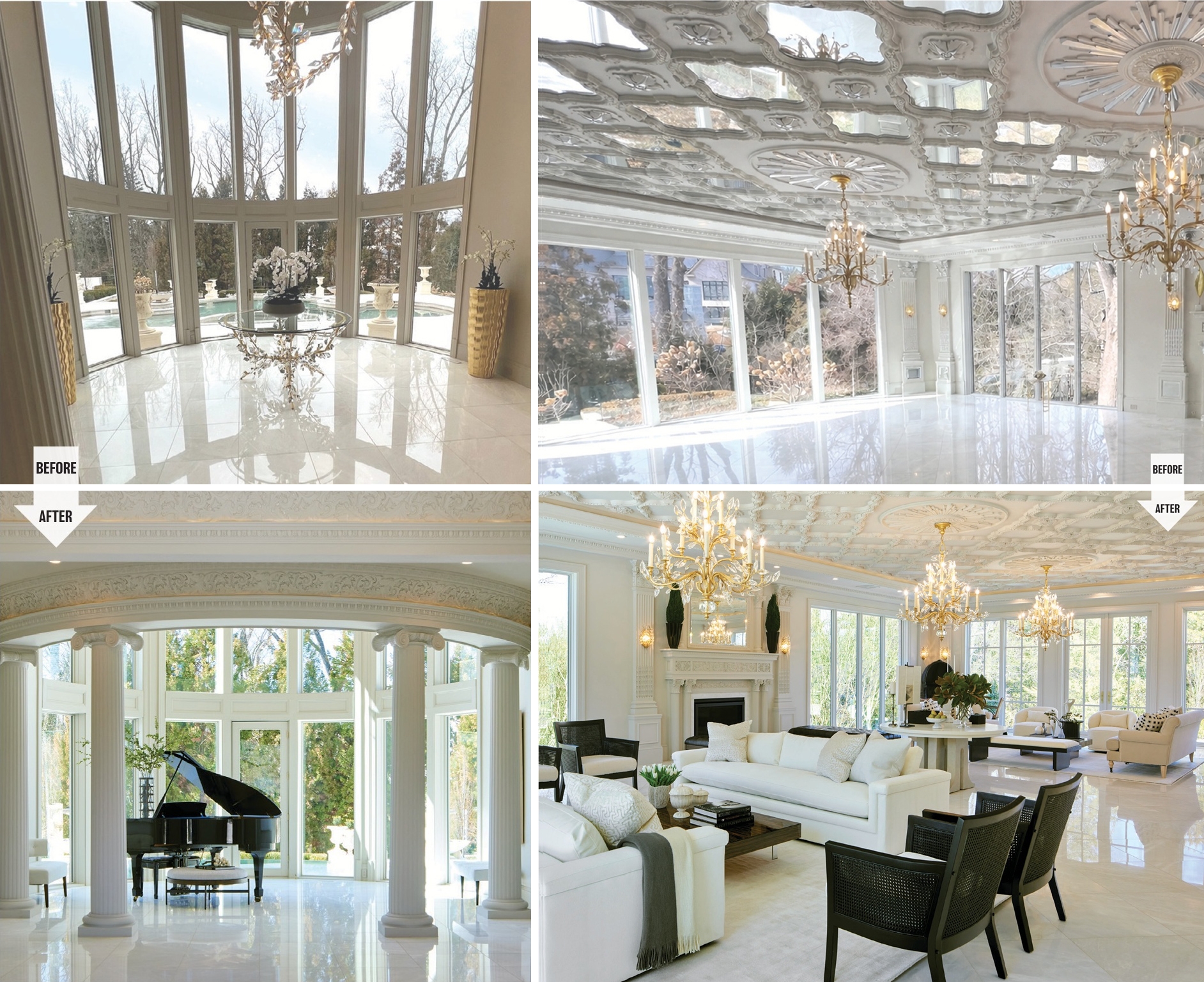
Removing mirrored ceilings (above top right) and adding furniture were among the restaging moves that retained the mansion’s luxury—but made it feel more livable.
That potential buyer, it seems, would love to entertain. “This house had a beautiful, enormous ballroom with a mirrored ceiling, three big chandeliers, and silver-painted embellishments on the walls,” Thomas says. “The front gate and front door had been embellished with gold, and the name of the property had been carved into the entrance columns.”
The location and amount of land, Thomas realized, were great, but the house was too opulent and formal. It needed to be tweaked to appeal to a broader buyer pool—although with ten bedrooms, 16 bathrooms, and an $18.5 million price, that pool would never be Olympic-size.

Many of the “beautiful but very taste-specific” touches were replaced by pieces chosen to “showcase the space for family reunions and philanthropic events.”
Thomas spent about $100,000 to stage the home with art and furniture that made the space look expensive but livable. He took away the mirrored ceilings and silver paint in the ballroom and staged it to become a living room with three seating areas. He removed the Chateau du Soleil logo from the columns. He covered up the gold paint on a 30-foot-high dome above the foyer to reveal the classic French architecture. On the lower level, he removed several full-wall mosaics, including one of pink swans and another of butterflies.
“They were beautiful but very taste-specific,” Thomas says. “We brought in pieces to showcase the space for family reunions and philanthropic events and staged the dining room to show how it could work for seated dinners for heads of state or top business leaders.”
Early in the staging process, one buyer made a low bid, which was turned down. In August 2025, six months after Thomas took on the project, it was purchased for $18.5 million. Once the first bidders saw the final staging, they were frustrated by “the one that got away” and offered $22 million for the house in October 2025.
“As far as I know,” Thomas says, “that’s the biggest flip in history in this area.”
The Hardest Sell
What happens when properties tied to murders, suicides, and violent crimes go on the market?
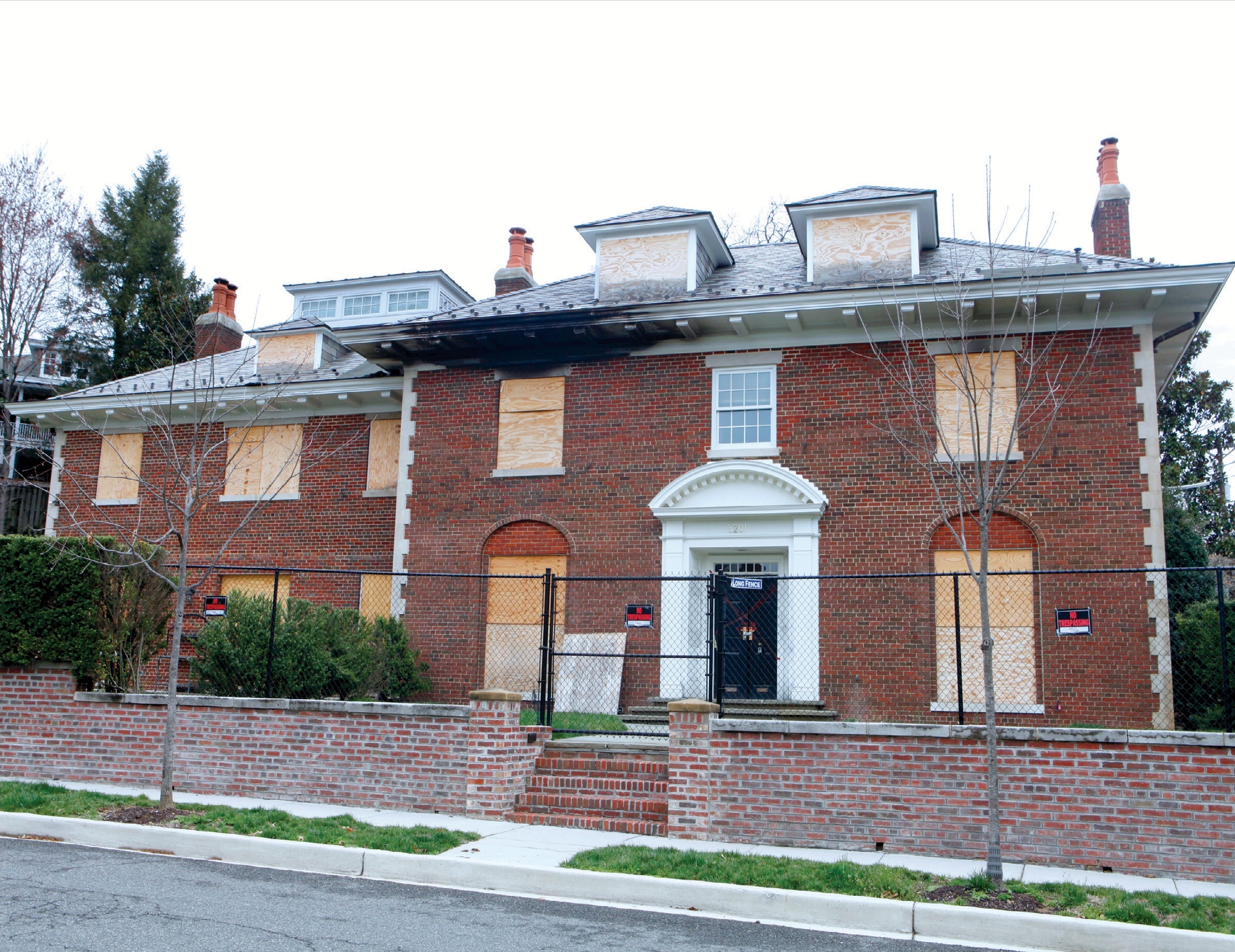
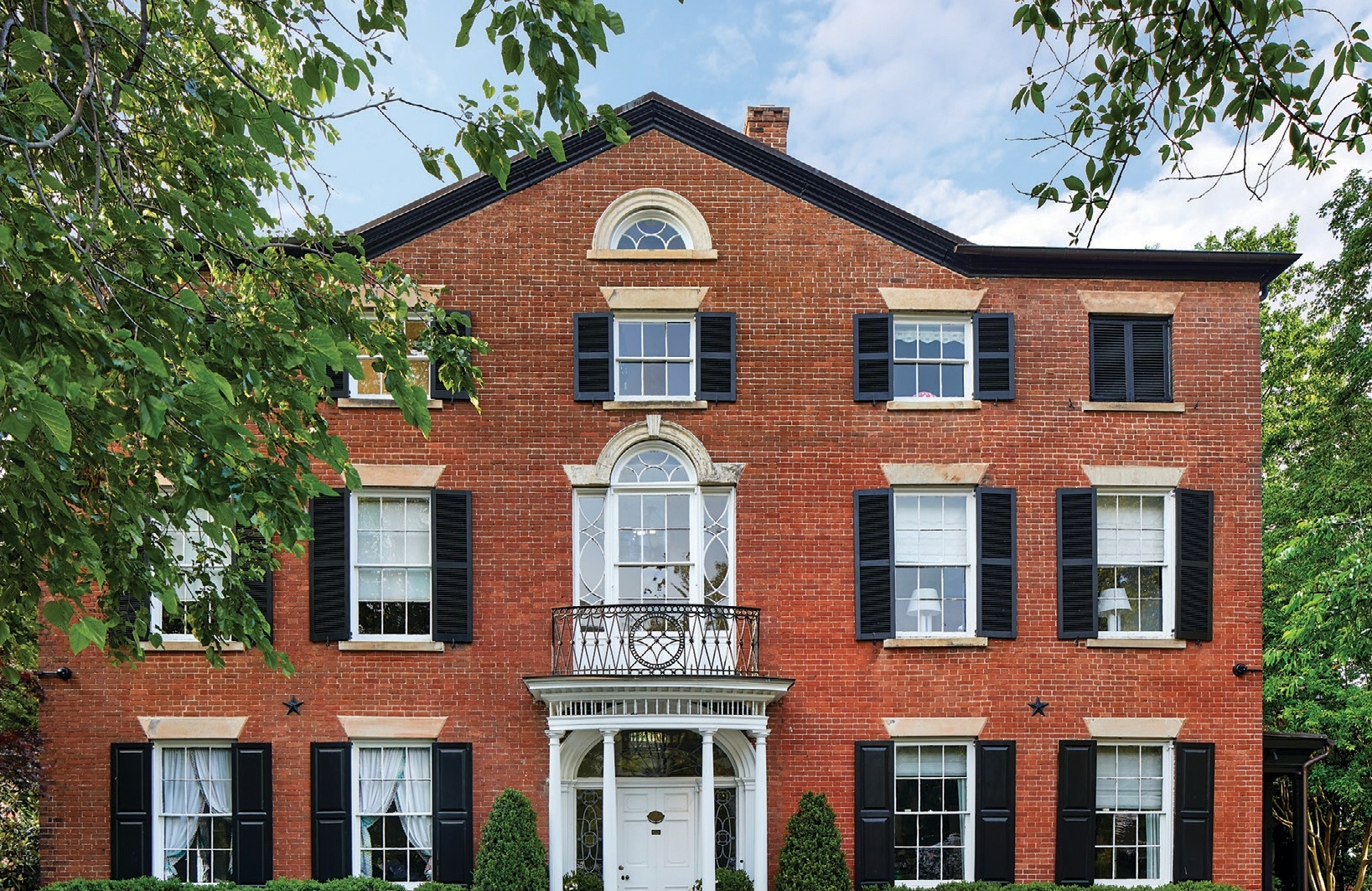
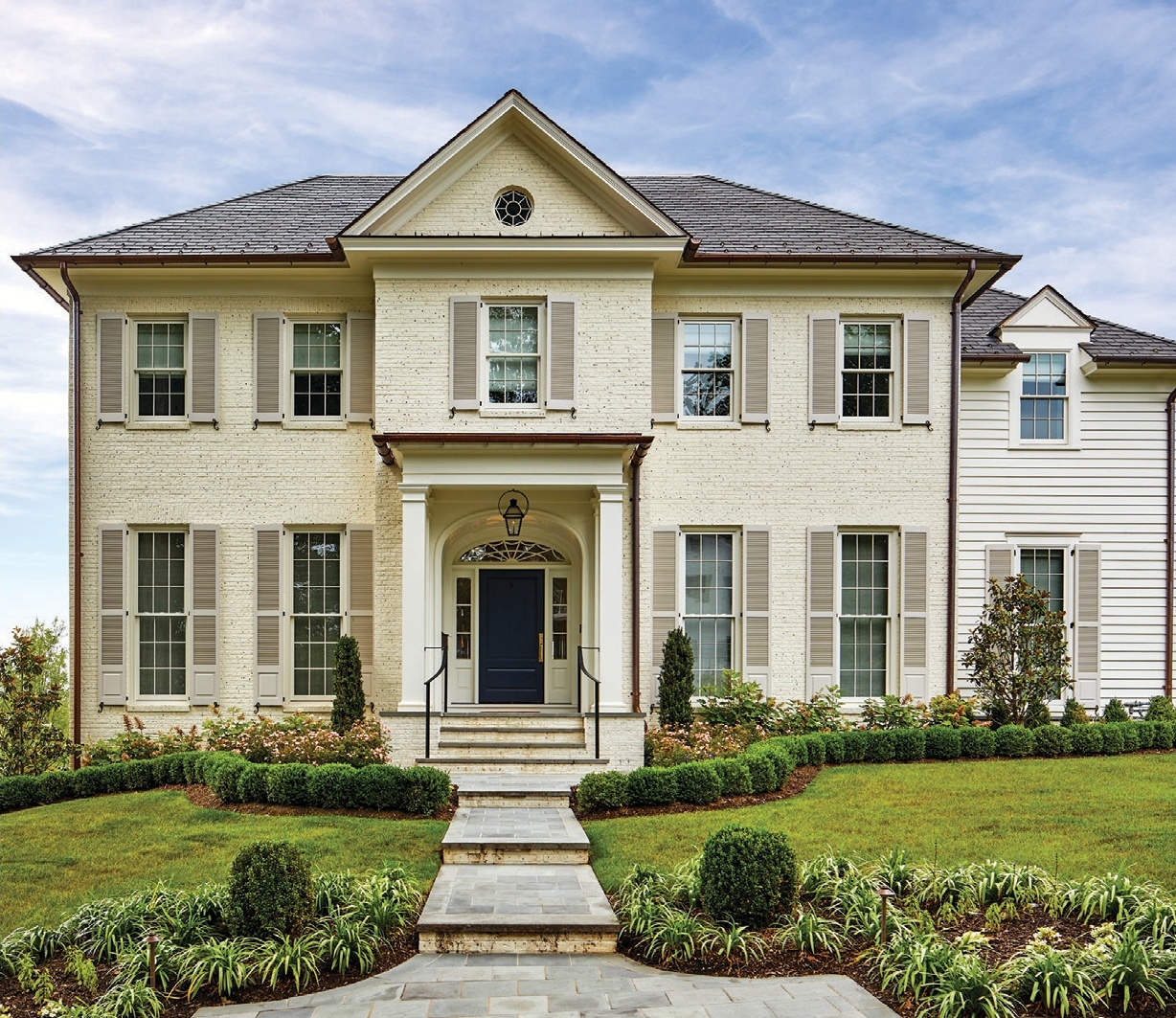
In the wake of the notorious 2015 “mansion murders,” the traditional brick Kalorama home at left was torn down and replaced by a modern house with a different street number.
In the aftermath of the unthinkable, the brick rowhouse on Sixth Street, Southeast, became something more than an address. Banita Jacks, a 33-year-old single mother, had killed her four young daughters inside the small, two-story home in the summer of 2007. When their bodies were discovered early the next year, it shocked the city and made national news—all while casting a pall over the property.
People walked by quietly. Some crossed the street, wanting distance from the eerie energy and the makeshift memorial of flowers and dolls that mourners had affixed to its chain-link fence. For a time, the property felt untouchable. It sat empty.
But even shrines to grief and despair eventually return to the market. When the 1,260-square-foot house sold in June 2009, it went for just $40,000—roughly 80 percent less than its assessed value of $220,610, and also well below the $189,000 it had sold for in 2005. Neighbors warned prospective buyers about what happened there and watched open-house visitors hesitate on the sidewalk as they weighed its deeply discounted price against its traumatic past.
In a high-demand region where bidding wars routinely engulf even modest properties, stigma is one of the few forces powerful enough to stall sales momentum. Homes tied to murders, suicides, and violent crimes—what real-estate agents call “stigmatized properties”—can leave buyers conflicted, creating a unique challenge for sellers.
“In some homes, when there’s a non-natural death, many carry a stigma,” says Paul Carrillo, deputy chair and professor of economics at George Washington University. “We know from [economic research] that those perceptions get capitalized into prices, at least in the short term. People don’t want to buy that house.”
What happens to properties with heinous histories? And how do they go from emergency sirens to staging to sale? While there are no hard and fast rules for rehabilitating their value, turnarounds take place across two dimensions: physical and psychological.
CONTROLLING CONDITIONS
Melanie Gamble, a real-estate broker in Upper Marlboro, remembers her first time dealing with a stigmatized property. In 2016, she was managing a client’s rental unit in Northeast DC when two tenants were shot and killed inside it.
Shaken, the owner chose to sell rather than continue leasing. Gamble handled the transaction. “Properties don’t sell for three reasons,” she says. “Number one is location. Number two is price. And number three is condition. You’re not going to move the house, so you can only control price and condition. So what can you do?”
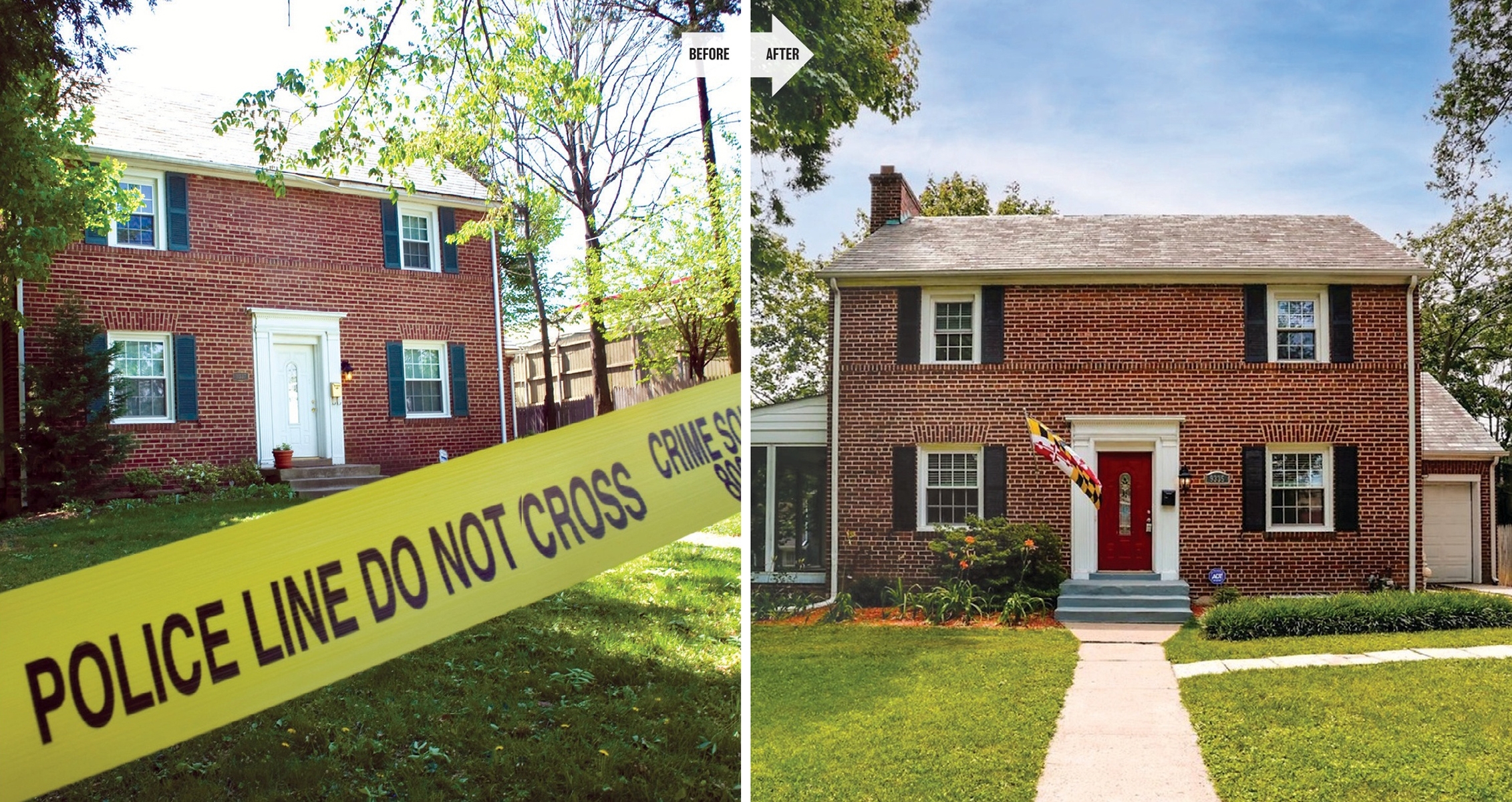
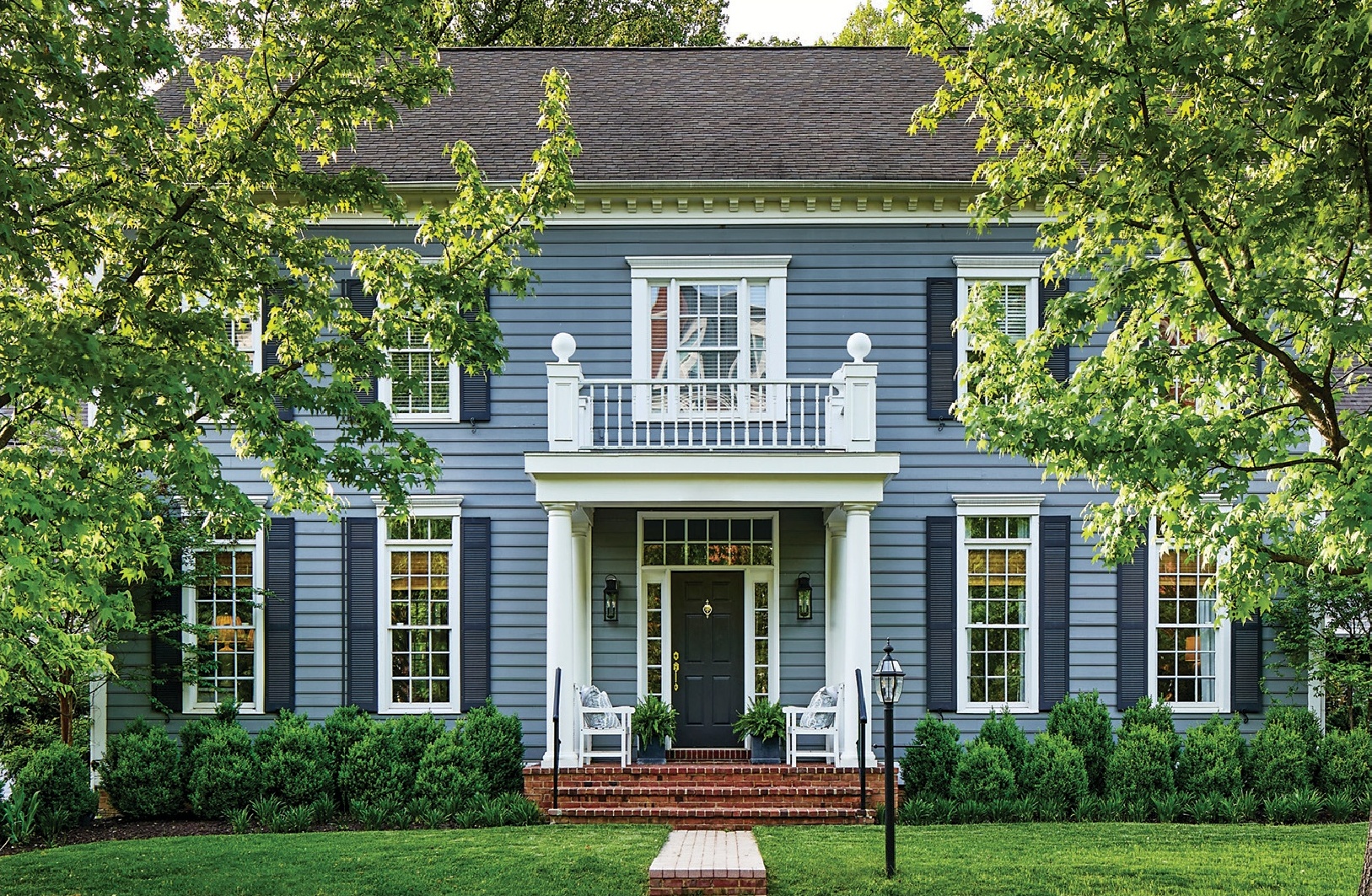
After three people were killed in two separate crimes at the same Silver Spring home (right), the so-called “homicide house” eventually ended up back on the market with a new street number.
Biohazard remediation is a typical first step. Once investigators clear a crime scene, professionals are called in to erase any trace of blood or other biological materials that may be on walls, floors, or ceilings. Likewise, porous surfaces including carpeting, drywall, and subflooring might be removed and replaced. Everything is disinfected using hospital-grade cleaning agents designed to eliminate pathogens that can linger long after a crime.
Governed by federal and local health regulations, this unglamorous process can take several days to a few weeks, depending on a property’s size and the extent of contamination. Once it’s finished, homes are considered safe for future owners and occupants.
Of course, safe isn’t always the same as sellable. In some cases, stigmatized properties are renovated into anonymity. In others, they’re razed and rebuilt. Following the 2015 “mansion murders”—three family members and their housekeeper were tortured and killed in their Kalorama house, which was then set on fire—the lot was demolished and later reintroduced to the market with a new structure and frontage address.
While address changes are rare, they do happen, severing an immediate, Googleable connection between a property and its sordid history. For instance, a Silver Spring home on Columbia Boulevard that was linked to three killings in two separate crimes became so notorious—acquiring the nickname the “homicide house”—that it now has a new street number. Laws in the District, Maryland, and Virginia don’t require sellers or agents to volunteer that a violent crime occurred inside a home, which means that prospective buyers may have to do their own research via news articles or DiedInHouse.com, a website that sells reports on the history of deaths at particular properties.
PRICE AND PERCEPTION
Buyers can usually tolerate a cracked walkway or an aging HVAC system, or make more serious structural problems part of price negotiations. But a dark past can be much harder to ignore—or quantify.
Expectations matter. If an incident occurs at a property in a neighborhood where violent crime is already common, Carrillo says, the fallout may not dramatically depress its selling price. By contrast, he says, “in a place where crime is rare, a single highly publicized event can feel seismic.”
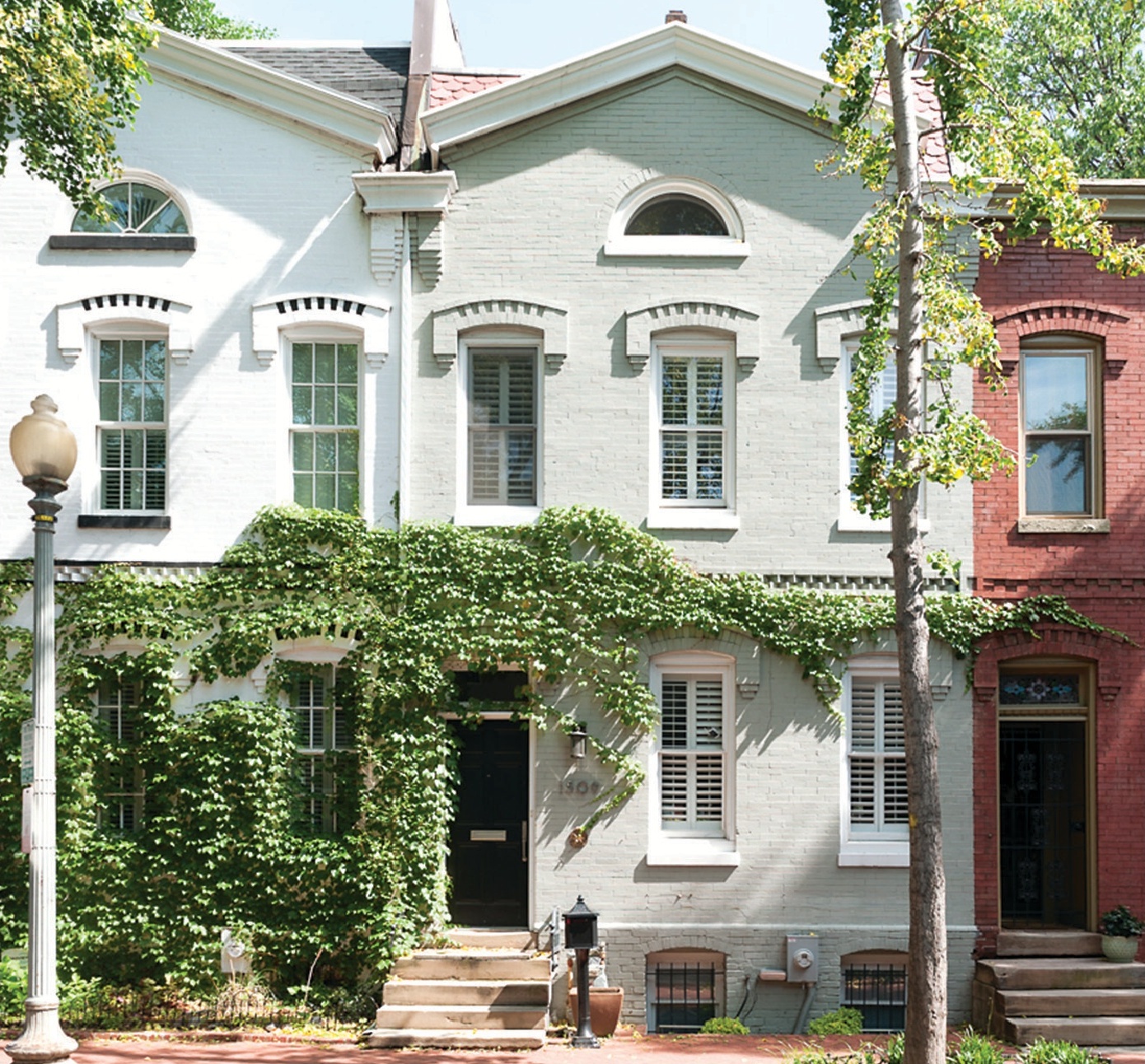
The site of an infamous—and still unsolved—murder in 2006, this Victorian rowhouse in Northwest DC sold for nearly $1.5 million in 2011—and again for $2.16 million in 2019.
According to Gamble, however, a surrounding neighborhood’s desirability can often matter much more than a home’s history. In tougher markets like Washington Highlands—where the rowhouse on Sixth Street, Southeast, sat in limbo—traumatic histories may act as one more price anchor. But in affluent neighborhoods where demand far outpaces supply, yesterday can carry less weight. In 2011, 91-year-old author and socialite Viola Drath was murdered in an upstairs bathroom of her Georgetown townhouse. Less than two weeks after it went on sale in 2013, multiple offers pushed the $995,000 list price to $1.2 million.
Over time, Carrillo says, even the most stigmatized properties become easier to sell. Headlines recede. Memories fade. “Markets tend to ‘forget,’ though sometimes slowly,” he says. Eventually, a tragic backstory becomes one more thing a buyer can live with—especially if the price is right. “If somebody had an incredible deal in a house they wanted, in a location they wanted, and then you came along and said, ‘Well, you know, they got shot in there the other night,’ I’d be like, okay,” Gamble says. Half-joking, she adds, “As long as the murderer doesn’t convey with the house.”
IS IT REAL OR AI?
Digital staging tools are increasingly popular—but not without drawbacks
Suppose you’re in the market for a new home and see a listing with what looks to be the kitchen of your dreams. Is it real? Increasingly, the answer may be no.
In an age when smartphones can doctor selfies, the same is happening in some real-estate listings: AI and virtual staging tools allow agents to insert furniture and features that don’t exist—sometimes even changing a home’s exterior. The idea is to help buyers visualize possibilities without a seller paying to physically stage or refresh the property.
Not everyone is a fan. “I think of it like dating—if the photos look great and then you show up and it’s not what you expected, people walk away,” says Daryl Judy, an agent with Washington Fine Properties in DC.
Some listing databases mandate that agents disclose instances when AI is used in photos. Even when it’s not required, agents say, transparency is best. “It’s imperative that buyers know what they’re looking at [with AI images] and that they know that when they to go to the house, it will be empty,” says Laura Sacher, a senior vice president with Compass in Alexandria. “I’ve had buyers think they’ve walked into the wrong property when they didn’t realize it was virtually staged.”
Digital and physical staging each have distinct advantages. Here’s how to choose what’s right for you.


Virtual staging offers endless options for furniture and artwork—and can be changed with a click.
WHY DIGITAL?
Lower cost. AI staging can cost as much as $50 a photo—though some can be done with free programs. Physical staging costs about ten times as much, says Joe Himali, an agent with the Best Address Group with RLAH @properties in Chevy Chase.
Quicker turnaround. Virtual staging is much faster because it can be done immediately, says Kris Paolini, a principal agent with Redfin in Rockville.
More design options. Virtual staging offers endless options for furnishings and artwork, Paolini says, with possibilities for instantaneous changes.
Filling a void. Some agents say virtual staging works especially well for vacant properties, to provide a sense of scale and layout.


While AI can help buyers envision possibilities, altered images can also foster confusion.
WHY PHYSICAL?
Better showings. If virtual staging is used because a house is empty, buyers may be disillusioned when they visit. “Using AI is a bait-and-switch,” says Elizabeth Lucchesi, an agent with Long & Foster in Alexandria. “My experience with AI-staged photos and a real tour has been [that the reality is] disappointing for buyers.”
Envisioning the space. Real staging can be crucial for small or awkward spaces, or very large ones where it’s hard to envision how someone would use the room. “When furniture is physically there, people understand the space immediately,” Judy says.
Emotional impact. People expect an in-person experience similar to what they see online, says Sammy Dweck, an agent with TTR Sotheby’s International Realty in DC: “I want people to like the property more in person than online.”
5 Common Staging Mistakes . . .
Entice buyers by avoiding these missteps—and by standing out

GOING TOO MINIMAL
Bland, cookie-cutter staging is a miss, says Kimberly Casey, an agent with TTR Sotheby’s International Realty in DC: “We work with stagers to build a layered look tailored to the buyer profile.”
STAYING SENTIMENTAL
“That cherished heirloom piece or bulky favorite table that seats 20 people—remove it,” says Kris Paolini, a principal agent with Redfin in Rockville. “Items that are of significance to you are not important to potential buyers.”
OVER-STAGING
“There’s a sweet spot between staging too much and staging too little,” says Laura Sacher, a senior vice president with Compass in Alexandria. “You do want to stage the main rooms—don’t do the living room and then no other room. But you don’t have to stage the whole house unless it’s very spacious with many rooms and you run the risk of buyers wondering what to do with a room.”
FORGETTING CURB APPEAL
Your front entry sets the tone for the whole house, says Brian Block, managing broker for RE/MAX Allegiance in Alexandria. Consider painting the front door, replacing dated lighting, and adding plants for a quick fix.
BEING STINGY
Sellers often don’t want to spend money on staging or do the bare minimum, says Daryl Judy, an agent with Washington Fine Properties in DC. But staging can increase the eventual sales price by as much as 10 percent, according to the National Association of Realtors.
. . . and One Stroke of Genius

GETTING IN SYNC
For a launch event in Cleveland Park, TTR Sotheby’s International Realty had synchronized swimmers perform in the home’s pool. “Keep in mind this was October and not exactly pool weather, which made the experience even more unforgettable,” Casey says. “We didn’t just want people to drop in. We wanted them to stay, to imagine entertaining there.” That meant curated music, food, and Casey’s “margarita recipe.” “The property came alive,” she says. “There were 150 people—there would have been more except the street got too crowded.” And in the end? “We got a full-price, all-cash offer at $5.995 million in three days.”
HOW TO MARKET A CONDO
Facing strong headwinds, here’s what sellers can still control
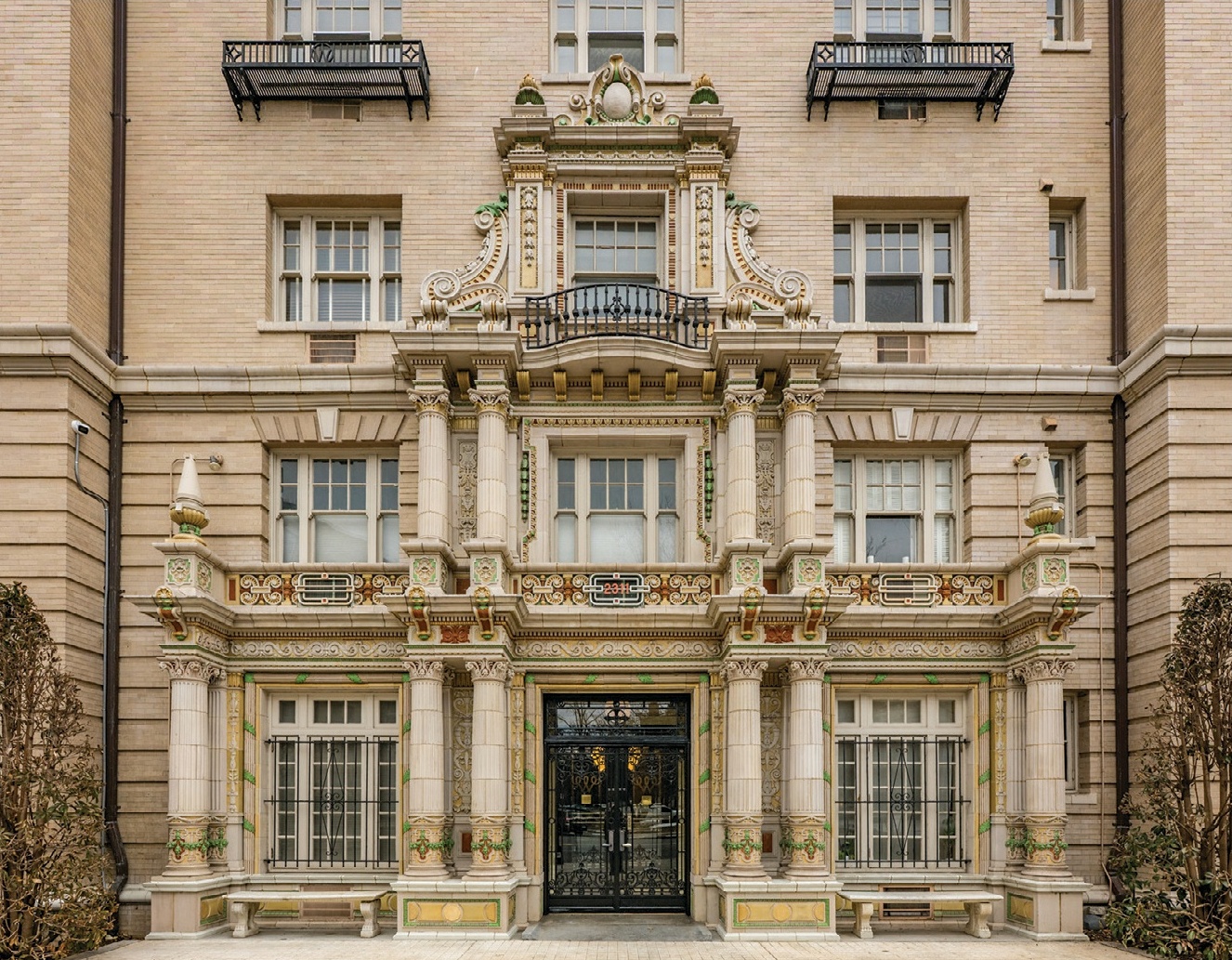
The semi-good news for condo sellers? Prices in the Washington area this past January dipped just 1.3 percent compared with January 2025, according to the multiple-listing service Bright MLS. The bad news? Just about everything else. Over the same time period, sales were down 22 percent. Listings now sit an average of 43 days, up from 32 last year.
Affordability is an issue. “For first-time buyers who want to make a low down payment, it’s not always cheaper to own than rent, especially with elevated interest rates and higher insurance costs,” says Morgan Knull, an associate broker with RE/MAX Gateway in DC. In some buildings, spiking monthly condo fees are exacerbating the squeeze felt by potential buyers. “They’ve increased a good bit in recent years due to the cost of everything from staff to management contracts to insurance going up,” says Sammy Dweck, an agent with TTR Sotheby’s International Realty in DC.

Condo sellers can stand out by highlighting superior finishes and craftsmanship.
Also contributing to sluggish sales: Supply outpaces demand in some neighborhoods, especially where there’s a glut of new buildings—such as DC’s Trinidad and H Street corridor, Knull says. Add it all up, Dweck says, and condo sales are “especially tough right now.”
Facing these headwinds, some owners are holding back their units from the market. But if you’re still looking to sell, here are three ways to improve your offering.
PRICE WINS
In the current market, Dweck says, pricing is more important than ever: “Buyers have more choices and no strong sense of urgency. Sellers are listing at prices based on comps from a different market climate. Sellers who succeed are the ones who have agents who help them understand the reality of the new market and who price significantly enough below the old comps to be the best value in a sea of listings.”

While sellers can’t control building amenities, staging can emphasize a condo’s strengths—making it feel more welcoming and valuable.
VIVE LA DIFFÉRENCE
According to Knull, the condo market is experiencing a “flight to quality”—so if your condo has special and in-demand features, flaunt them. “Condos that have a differentiator such as private outdoor space, a nice view, desirable amenities, and high-quality finishes and craftsmanship are easier to sell,” Knull says. “In-unit laundry and pet-friendly buildings are a big thing with buyers, along with how package delivery will be handled securely.”
SELL YOUR STRENGTHS
Sellers can’t control what amenities a building provides, but the right marketing can help a listing stand out. Highlight the amount of light a unit receives. Talk about what residents can walk to nearby. Provide a simple summary of the condo fees and what they cover. And mention recent building improvements, says Brian Block, managing broker of RE/MAX Allegiance in Alexandria, “to reassure buyers of the value.”
PHOTOGRAPHS: STACY ZARIN GOLDBERG; TTR SOTHEBY’S INTERNATIONAL REALTY; ADAM ALBRIGHT; ANDREW PROPP; EVY MAGES; SARAH L. VOISIN/ WASHINGTON POST VIA GETTY IMAGES; BRIGHT MLS; COURTESY OF KRIS PAOLINI; COURTESY OF KIMBERLY CASEY TEAM; COURTESY OF KIMBERLY CASEY TEAM; NATHAN STEWART; LAUREN MORTON PHOTO/ COURTESY OF LAURA SACHER AT COMPASS. DESIGN CREDITS: CONVENE ARCHITECTURE AND MARKS WOODS BUILDERS; THOMSON COOKE ARCHITECTS, ZUCKERMAN BUILDERS, KATY ANDERSON INTERIORS; CATHY NEWMAN INTERIORS; NICHOLAS STANOS ARCHITECTURE; THORSEN CONSTRUCTION, COURTNEY COX INTERIORS; ALI FRYE INTERIORS; ERICA BURNS INTERIORS, GTM ARCHITECTS, JOSEPH RICHARDSON LANDSCAPE
















LIFE, TRAVEL & STYLE
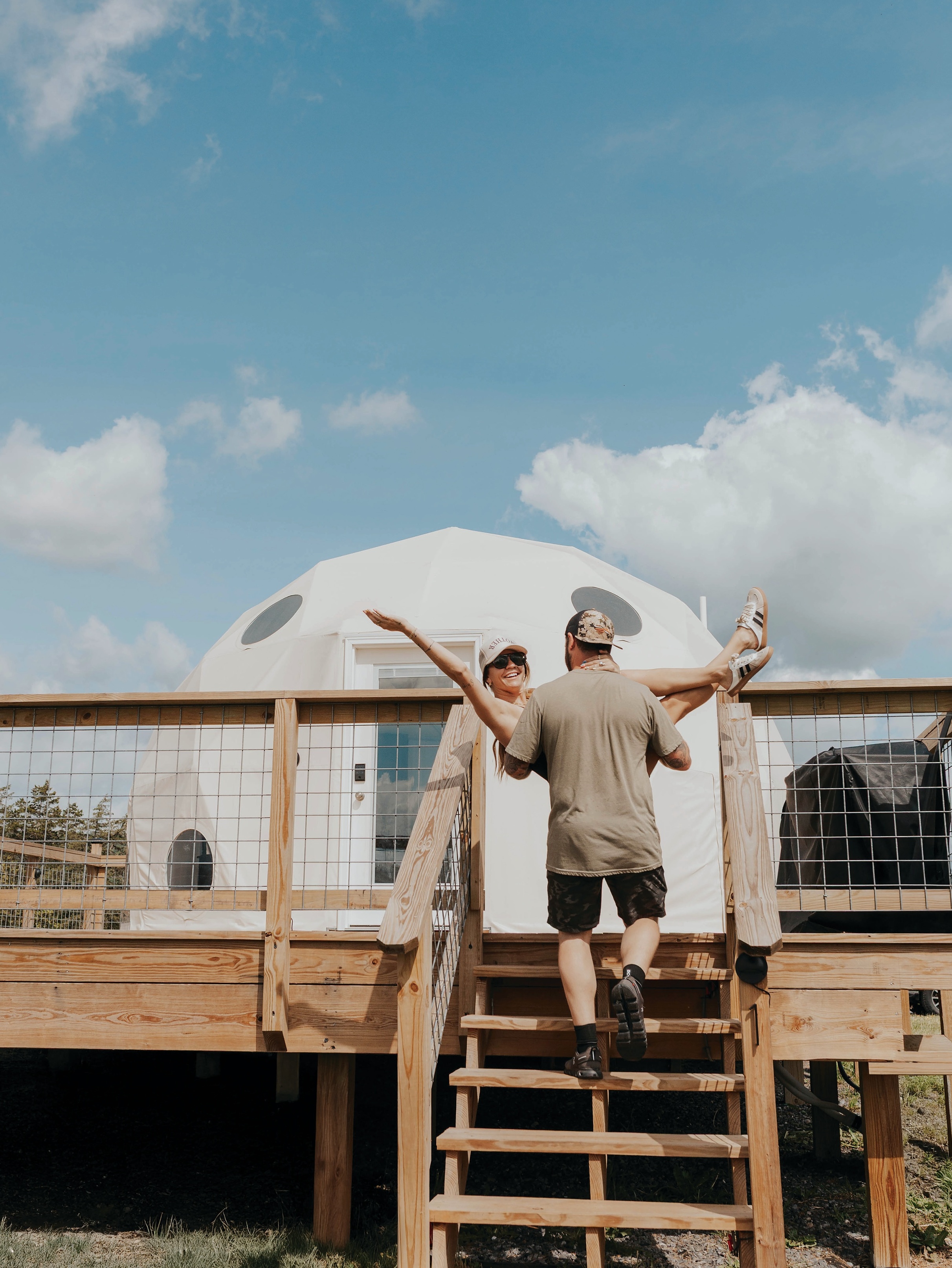
HAPPY CAMPERS
Turn the page for camping destinations, such as these geodomes at Faraway in Luray.
PHOTOGRAPH BY KAT LANGFORD PHOTOGRAPHY/COURTESY OF FARAWAY
LIFE, TRAVEL & STYLE / CAMPING
Pitch Perfect
There’s a camping site for everyone, from tents on the beach to luxe glamping domes


1. FAIRY STONE STATE PARK
Stuart, Va.
Just off the Blue Ridge Parkway outside of Roanoke, this enchanting getaway is dotted with well-equipped cabins, yurts, and campsites. Take imaginative kids on a treasure hunt for cross-shaped fairy stones (staurolite crystals), then hit the 168-acre lake for fishing, boating, and swimming, or hike one of 11 trails crisscrossing the property.
Distance from DC: Four and a half hours
2. LITTLE BENNETT CAMPGROUND
Clarksburg, Md.
The charming woodland campsites exude tranquility. Leisurely activities include strolling or biking 30 miles of trails dotted with historical sites–including a sumac mill, whiskey distillery, and chapel cemetery- or participating in themed weekend programming, such as superhero training camp and a Bigfoot celebration.
Distance from DC: 40 minutes
3. LUMS POND STATE PARK
Bear, Del.
On the shores of Delaware’s largest freshwater pond, find paddleboarding, canoeing, and kayaking opportunities galore (rentals are available), as well as fantastic fishing. On terra firma, hike loop trails, play disc golf, and whiz through the trees at the Go Ape Zipline & Adventure Park.
Distance from DC: An hour and 50 minutes

4. TIMBERLINE GLAMPING CO.
Williamsburg, Va.
These deluxe safari tents, on the banks of the Chickahominy River, come outfitted with a king bed and two sets of bunk beds for kids. Add outdoor entertainment options such as giant Jenga, cornhole, inflatable kayaks, and bicycles so everyone can stay (relatively) screen-free.
Distance from DC: Two and a half hours
5. FARAWAY
Luray, Va.
Outfitted with a king bed, kitchenette, and bathroom, the temperature-controlled geo-domes somehow feel both futuristic and rustic. Sit on the porch in front of your blazing fire pit, where you can take in breathtaking views of the Blue Ridge Mountains and night skies unpolluted by city lights.
Distance from DC: An hour and 40 minutes
6. CUNNINGHAM FALLS STATE PARK
Thurmont, Md.
Pitch your tent at the William Houck Campground (open April to October) or the year-round Manor Area Campground. Then visit the aviary to get up close and personal with raptors and reptiles. Starting Memorial Day weekend, pop over to Hunting Creek Lake for a cooling dip or fishing session. Hiking options include a trek to the namesake waterfall.
Distance from DC: An hour and 15 minutes
7. OAK RIDGE CAMPGROUND
Triangle, Va.
No-frills forested campsites are equipped with a grill, picnic table, and fire pit (BYO wood). Make sure to book a site in the B loop for the best access to showers. The area is pet-friendly, and when it’s time to walk the dog, you can take advantage of several well-maintained trails through surrounding Prince William Forest Park.
Distance from DC: One hour

8. ASSATEAGUE ISLAND
Berlin, Md.
Pitch your tent in the dunes at one of the oceanside sites, where you can enjoy radiant sunrises and unfettered views of the universe at night. Just be prepared for harsh sun, whipping winds, and insistent mosquitoes–all worth enduring to savor the majesty of this rugged island and its legendary wild horses.
Distance from DC: Two hours and 45 minutes
PHOTOGRAPHS: COURTESY OF VIRGINIA DEPT. OF CONSERVATION AND RECREATION; COURTESY OF M-NCPPC, MONTGOMERY PARKS; BY KALI ANN LISK/COURTESY OF TIMBERLINE GLAMPING CO.; COURTESY OF NPS PHOTO; COURTESY OF FARAWAY
LIFE, TRAVEL & STYLE / STYLE
Suit Yourself
Menswear is getting a dramatic update, says style influencer Barnette Holston (@DCFashionFool), with fuller pants, broader shoulders, or wider lapels. Here, he wears his favorite suit in this style, by Enzo Custom, paired with a Swarovski brooch. Below: more ways to get the look.












PHOTOGRAPHS: CHI-CHI ARI; COURTESY OF BRANDS
LIFE, TRAVEL & STYLE / HEALTH
Best Dentists
The top orthodontists, periodontists, general dentists, and other practitioners who can treat your teeth. Did yours make the list?

IF YOUR CHILD NEEDS BRACES OR you’ve cracked a molar or developed a toothache, you want a dentist you can trust. What follows are about 800 of them.
To come up with this list of the area’s top dental pros, we asked thousands of local dentists which of their peers they most recommend. After all, dentists routinely see one another’s work.
We partnered with a firm called top-Dentists, which mailed a ballot to every area practitioner listed online with the American Dental Association, as well as those listed online with local and national dental societies—giving virtually every dentist in this region a chance to vote. Participants were presented with lists of dentists in their immediate area and invited to rate them on a scale of 1 to 5, with 5 being “excellent.” They were asked to vote only on peers whose work they personally know and to put aside personal bias. They were asked to take into consideration years of experience, continuing education, manner with patients, use of new techniques and technologies, and of course physical results.
The scores were compiled and averaged; the average required for inclusion varied by specialty and geographic area. Previous awards and status in dental academies were also sometimes a consideration. Once we had a list of finalists, the names were checked against state dental boards for disciplinary actions and to make sure each practitioner has an active license and is in good standing. For more information on the process, you can call 706-364-0853; write PO Box 970, Augusta, GA 30903; email help@usatopdentists.com; or visit usatopdentists.com.
Because inclusion here is based on the subjective judgment of peers, many good dentists may be missing. The topDentists firm remains confident that its methodology largely corrects for biases and produces the most reliable, useful list of top-rated dentists.
GENERAL DENTISTRY
PHOTOGRAPH BY LISA WILTSE/GETTY IMAGES










































TASTE

TASTE THE RAINBOW
Bagels are coming in all sorts of wacky flavors these days. Turn to page 147 for more.
PHOTOGRAPH BY LAUREN BULBIN
TASTE / REVIEWS
Roll Play
Our critic checks out two hot new Japanese spots

Katsumi’s lobster with golden egg sauce
DC’S JAPANESE FOOD SCENE HAS BEEN fast expanding with omakase bro destinations, fast-casual places, chirashi spots, and fusion steakhouses. Here’s a look at two notable newcomers.
Katsumi
In Logan Circle, the French/Japanese restaurant Bar Japonais has a new look, a new name, and a new vibe. Katsumi, with its plum velvet couches, pink neon, and weekend DJs, made its entrance in mid-February.
And while the place looks like it’s more of a destination for Bumble dates over strawberry-matcha cocktails (it’s open till midnight on weekends), the owners have wisely held onto one important element from its past: Masaaki “Uchi” Uchino—the talented chef who once ran the omakase counter at Sushi Nakazawa.
There’s no sushi counter at all at Katsumi, which has been packed on recent weeknights, and Uchino is freed up to play around. One of my favorite rolls, with caviar, black porgy, and crispy potato bits, nods to sour-cream-and-onion chips. Another winner pairs escolar and avocado with scallion tempura and scallion oil. Skip the salmon sashimi, which arrived in a befuddlingly bland sauce of passionfruit and ají amaril-lo, and instead go for Uchino’s quail-egg-crowned take on tuna tartare, a standout rendition in a very crowded field.
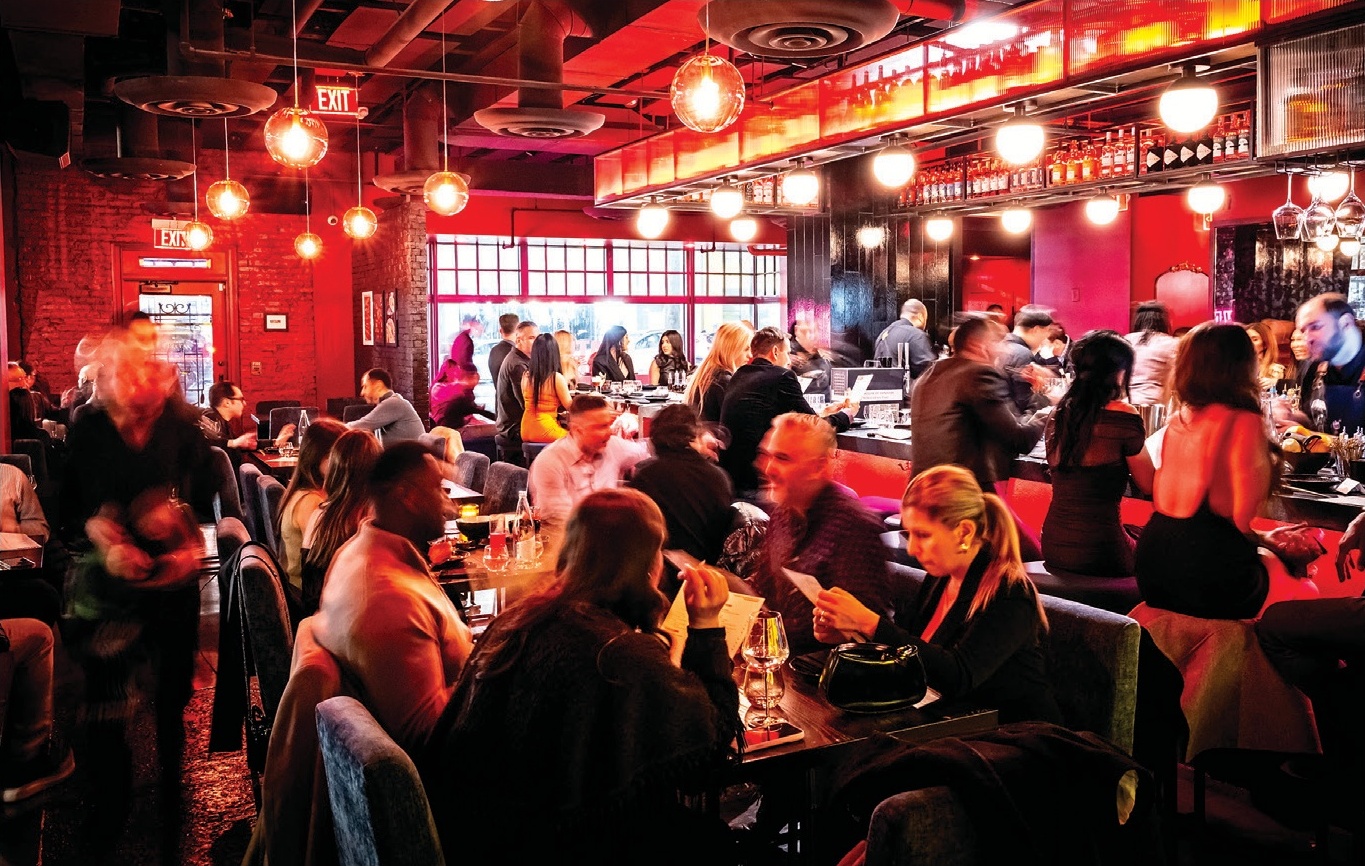
A busy night at Katsumi
On the more traditional side, there’s well-crafted nigiri with the usual suspects (king salmon, hamachi, spot prawn), plus luxe ingredients like toro, uni, and A5 Wagyu. As at Nakazawa, the rice was perfectly vinegared.
Another chef, Kappo alum Jhony Bautista, oversees the menu of bar snacks, noodles, and skewers. I loved the oblong gyoza stuffed with minced beef and cabbage, the ultra-crunchy pork katsu, and the tempura-fried rock shrimp with honeymiso mayo. I didn’t love the soggy heap of yuzu-scented shishitos—or the fact that a bunch of those plates showed up all at once for a round of the least fun game in the world: table Tetris.
Maru San
I have good news and bad news about Maru San. The positive: The Japanese/Peruvian fine-casual spot is easily the best restaurant to open in DC so far this year. But if you have PTSD from shivering in line a decade ago for a seat at Bad Saint or Rose’s Luxury (or, more recently, for a burger at Eebee’s), I’m sorry to tell you that this is a sliver of a space with 25 seats and no reservations, save for a separate tasting menu that accommodates just four people a night (and is already sold out for months).
The Eastern Market spot, which opened in February, drew immediate crowds thanks to its owner, the James Beard Award–winning chef Carlos Delgado, also behind the Shaw tasting room Causa. Here, the Peruvian native—along with Tiger Fork’s Simon Lam—focuses on the Nikkei strain of his country’s cuisine, influenced by a wave of Japanese immigrants who arrived on a boat called the Sakura Maru at the turn of the 20th century.

Maru San dry-ages its Japanese fish.
The centerpiece of the menu is a lineup of hand rolls: sheaths of shatteringly thin nori filled with warm koshihikari rice and fillings such as sweet raw scallops with a Parmesan-butter sauce, Old Bay–scented lump crab, or shrimp spooned with vibrant huacatay aïoli. You can order them à la carte, but the $37 set of six is the way to go—they arrive one at a time, and each is delicious in its own way. The lone middling roll I tried, filled with a dull mix of foie gras and miso, came from the “premium” list. It’s the only one that needed a flavor boost from the housemade soy sauce, served on the side.
As memorable as the hand rolls are, some of my favorite dishes came from the short menu of share plates, where Delgado’s artistry with ceviches and tiraditos is on display. (He sources Japanese fish from the same purveyor that services the far more expensive Causa.) Thin slices of flounder get a kick from tiny sea grapes and a bright, punchy leche de tigre laced with hojicha-smoked ají amarillo peppers. Don’t miss nubs of octopus in a briny, creamy sauce made from blanched Peruvian olives and vegan mayo, served with a small package of saltines. Or slices of lightly seared A5 Wagyu tataki with grapefruit ponzu.
Though Delgado started working on Maru San three years ago, the place feels quite timely. It’s relatively affordable. There are no servers—you check off whatever you want on a sheet of paper, and one of the handful of cooks behind the counter will give it to you. There’s also no kitchen, just a lineup of rice cookers and induction plates. And yet every detail—whether the custom-made stones your hand rolls arrive on or the perfectly calibrated reggaeton and ’90s hip-hop soundtrack—has been considered. Tiny octopus figurines hold your chopsticks. Look up and a full-ceiling painting of half an octopus cleverly runs alongside a mirror, giving the optical illusion of a larger space. Maybe someday.
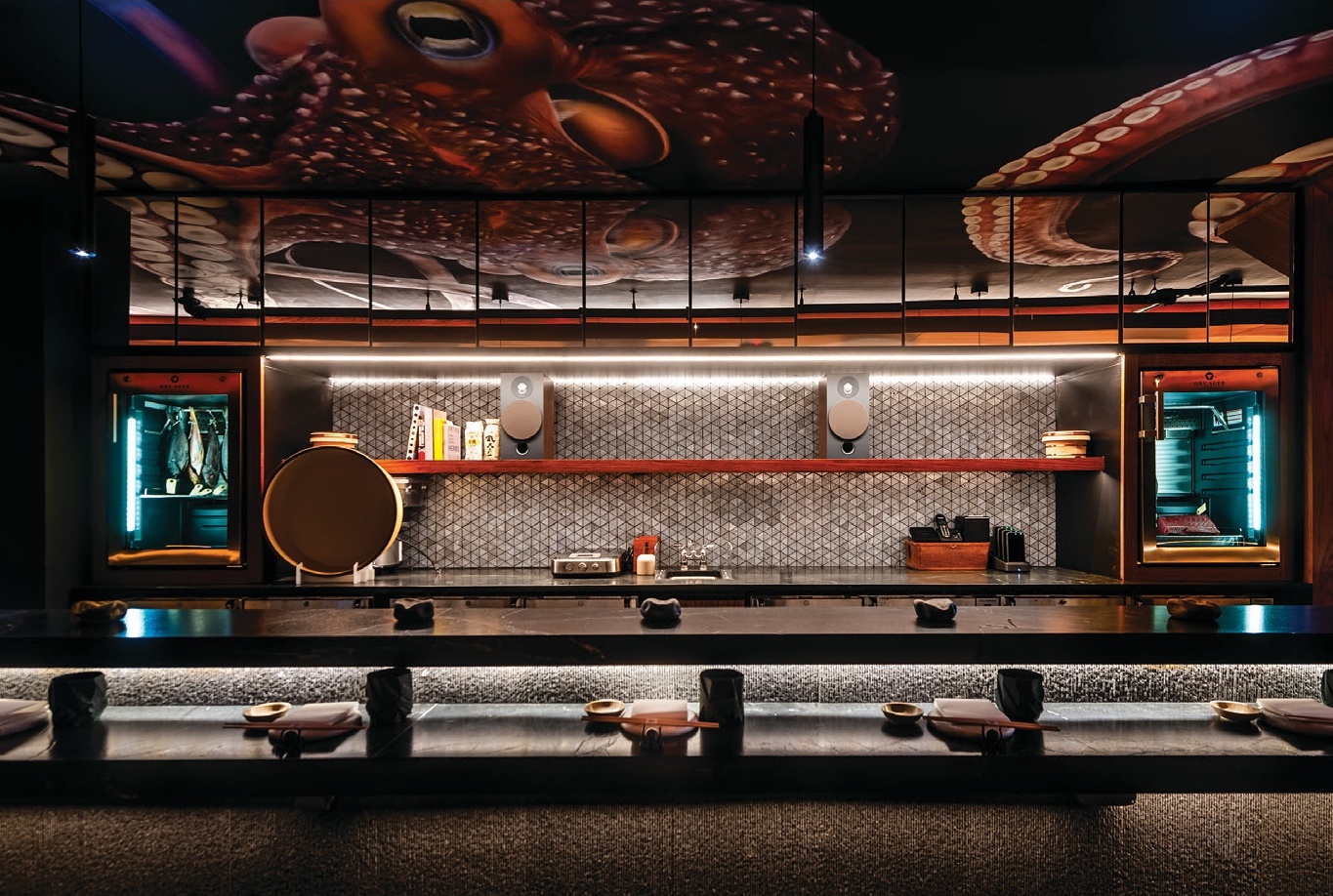
Maru San’s counter-the only place to sit
Katsumi
1520 14th St., NW
Open Tuesday through Sunday for dinner
Neighborhood: Logan Circle.
Dress: It’s a casual crowd but a trend-conscious one (especially later at night).
Best dishes: Sour-cream-and-onion roll; escolar-and-scallion roll; tuna tartare; rock-shrimp tempura; gyoza; pork katsu.
Price range: Maki $11 to $19, sashimi plates $21 to $65, share plates $13 to $44.
Bottom line: A serious destination for sushi and Japanese snacks, even if it doesn’t look the part.
Maru San
325 Seventh St., SE
Open Thursday through Monday for dinner
Neighborhood: Eastern Market.
Dress: It’s dark and everyone is seated at a horizontal bar–nobody will care what you’re wearing.
Best dishes: Crab, scallop, shrimp, and spicy-tuna hand rolls; Wagyu tataki; octopus with olive sauce; ceviche; flounder tiradito.
Price range: Hand-roll sets $22 to $37, à la carte hand rolls $7 to $35, share plates $9 to $45.
Bottom line: This tiny, no-reservations hand-roll bar is DC’s best new restaurant so far this year.
PHOTOGRAPHS: SCOTT SUCHMAN; REY LOPEZ
TASTE / HIDDEN EATS
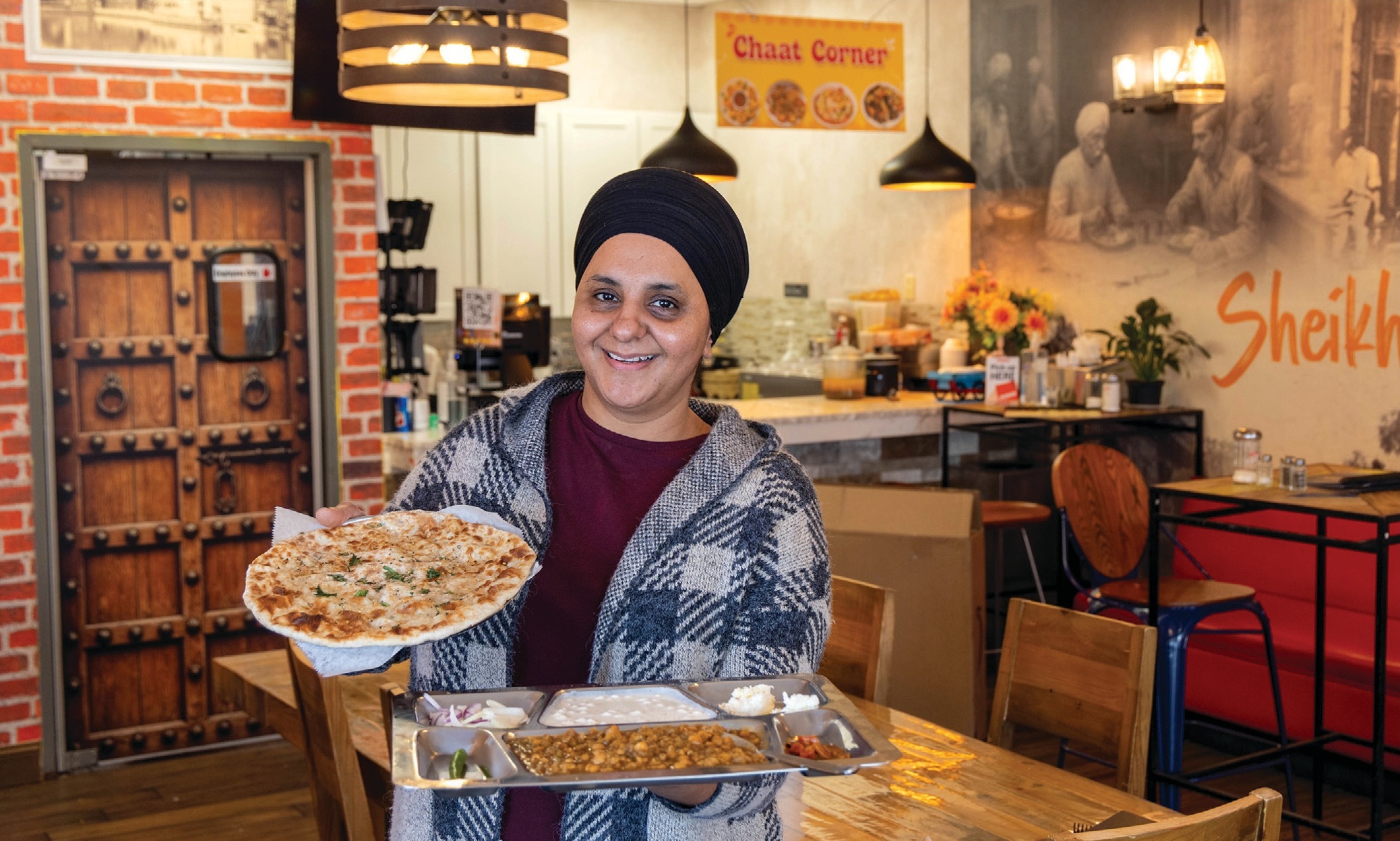
Sandeep Kaur shows off one of 323 Dhaba Express’s specialties: bread.
Tandoor Stop
A hearty- and vegetarian–Indian restaurant is spicing up Sterling
EXIT 323 ON INTERSTATE 81, NEAR THE Virginia/West Virginia border, looks a little desolate. There’s an Amazon warehouse, a fireworks store, a Methodist church, and some mobile homes and old houses along Martinsburg Pike. One business does stand out, though: 323 Dhaba Punjabi Veg Kitchen, a low-slung truck-stop diner advertising Northern Indian regional specialties in the middle of the Piedmont farmland.
The owner is Jasdeep Singh, a longtime trucker from the Punjabi village of Chamkaur Sahib, who settled down in Virginia in 2022 to run a truck-repair business. A year later, he added a vegetarian restaurant by popular demand. Hundreds of thousands of Punjabi Sikhs work in trucking in the US—about 20 percent of the industry’s workforce, by some counts—and Singh says about half his West Virginia customers are truckers.
Last November, Singh and his wife, Sandeep Kaur, opened their second location much closer to DC, near Dulles Airport. At 323 Dhaba Express, they’re catering to Loudoun County’s Indian community—more software and IT workers than truckers.
The menu at both locations is all vegetarian but no less hearty for it. Curries such as dal tadka (split-lentil stew) and kala chana (black chickpeas) are enriched with plenty of ghee. Punjab, sometimes called “the granary of India,” is known for its roti, paratha, naan, and kulcha. Fittingly, 323 Dhaba serves some of the best Indian breads in the area, all cooked to order in the restaurant’s tandoor oven. Parathas—as wide and oven-blistered as Neapolitan pizzas—can be stuffed with potatoes, cauliflower, paneer, or all the above. Lachha paratha is flaky and layered like a Malaysian roti canai. Makki di roti, a supple corn flatbread, is traditionally paired with creamy mustard greens.
The most impressive product of the tandoor is Amritsari kulcha, a stretchy flatbread stuffed with potatoes and dotted with crushed coriander seeds. A meal in itself, the kulcha arrives with a tray of condiments: salted butter, sliced onions, chickpea curry, green chilies, pickles, and raita with a confetti of fried chickpea flour.
The bread is named for the Sikh holy city of Amritsar, which is pictured on the walls of the restaurant. A message nearby offers a history lesson on India’s partition, which split Punjab between that country and Pakistan in 1947. It memorializes the death and displacement of millions because of decisions made “by those who were neither Punjabi nor ever lived in Punjab.”
For restaurant decor, it’s unusually solemn, and it speaks to Singh and Kaur’s desire to tell the full story of Punjabi culture through food.
“Here in Northern Virginia at 323 Dhaba Express,” the message reads, “we bring you the authentic taste from Punjab, the land of five rivers, along with our stories of sorrow, joy, and hope.”
323 Dhaba Express, 20800 Pidgeon Hill Rd., Sterling
PHOTOGRAPH BY EVY MAGES
TASTE / TRENDS
Bagels Gone Wild
Apparently, everything isn’t enough. These days, bagel makers are crafting rounds with surprising ingredients–from sweet to savory to eye-catching. Here are six that will drive purists crazy.

1. Chocolate Chip
Goldberg’s New York Bagels
These NYC–inspired kosher bagel shops in Montgomery County add a deluge of dark-chocolate chips to their rings, making you feel like you’re eating a cookie for breakfast. 9328 Georgia Ave., Silver Spring; 4824 Boiling Brook Pkwy., Rockville.
2. Cheesy Garlic Bread
Call Your Mother
These garlicky circles, bubbly with cheese, were created as a foundation for the meatball bagelwich at this Miami Vice–hued bagel chain. The seasonal bagels became so popular that they’re now a long-term menu item. Multiple area locations.
3. Rainbow
Bethesda Bagels
Prismatic bagels, swirly with food coloring, are Instagram thirst traps. These are available only Friday through Sunday in limited numbers. Bethesda, Cabin John, Rockville, Navy Yard, and Rosslyn.
4. Old Bay–Sesame
Buffalo & Bergen
Pairing bold Chesapeake vibes with a subtler nutty undertone makes these disks popular for tuna-salad sandwiches and BEC breakfast sandos at Gina Chersevani’s homage to New York’s corner delis. 3501 Connecticut Ave., NW; 1309 Fifth St., NE; 240 Massachusetts Ave., NE.
5. French Toast
Brooklyn Bagel Bakery
Arlington’s longtime bagel pros evoke the sweet breakfast favorite by adding eggs to their dough, rolling the unbaked rounds in cinnamon and sugar, then finishing them off with powdered sugar. 2055 Wilson Blvd., Arlington.
6. Cinnamon Sugar
Chewish Deli
The blue-and-white-accented corner bagelry in Old Town rolls its bagels in an aromatic spice blend that recalls just-baked snickerdoodles. 807 Pendleton St., Alexandria.
PHOTOGRAPHS BY LAUREN BULBIN
TASTE / BAKERS
Sweet Home
A bakery doesn’t require a cute storefront and glass cases brimming with sweet treats. With a cottage license, any enterprising baker can run a business out of their home kitchen. Here are four pros who craft everything from flower-inspired cupcakes to artisanal breads.

Jill Nguyen
Capitol Jill Baking
Call it carb diplomacy. When Jill Nguyen moved into her Capitol Hill rowhouse at the end of 2020, she brought homemade bread to all her new neighbors to introduce herself and her home bakery. She told them, “If you see a random person walking down the street with a brown bag, it’s not drugs—it’s just bread.”
Two days a week, the self-taught 32-year-old and her crew of four rotating helpers work in her 300-square-foot kitchen outfitted with a conventional oven, a bread oven, and a 32-quart spiral mixer. Bread day is Tuesday or Wednesday, when she typically offers three types of sourdough, a baguette, and slices of cake, perhaps peach Melba or chocolate stout with orange. On Sundays, she focuses on an ever-changing variety of baked goods: cinnamon buns, biscuits with honey and chili crisp, and chewy pretzel bagels.
Everything is preordered, and a neighborhood kid sets up a table outside Nguyen’s house, selling lemonade in the summer, apple cider in the fall, and hot chocolate in the winter. Folks in line to pick up their orders chat and admire one another’s dogs. “There is a sense of community and a vibe,” says Nguyen. CapitolJillBaking.com.

Alex Reponen
Dapper Fox Bakery
In another life, Alex Reponen was a CIA operations officer, “recruiting spies and stealing secrets,” as he puts it. But on the side, he was developing a passion for baking, which he started pursuing after leaving the agency in 2015. After working for the team who went on to open Pluma by Bluebird Bakery in Union Market, Reponen launched a cookie business of his own in 2020.
The 48-year-old follows the same routine every week. Monday through Wednesday, he transforms his “too small” Alexandria home kitchen into a bakery, utilizing every square inch of horizontal space to make roughly 25 batches of dough, which he sells as ready-to-bake frozen cookies in bags of six. Generally, he offers one flavor a week, such as cookies and cream, chocolate chip, and Heath Bar crunch. Since opening, Reponen estimates he’s sold a quarter million cookies. “That’s a lot of butter, eggs, sugar, and scooping,” he says.
Later in the week, he does cookie drop-offs throughout the area. It all feels a world away from his career in spycraft. “I get a lot more blisters and do a lot less typing,” he says. DapperFoxBakery.com.
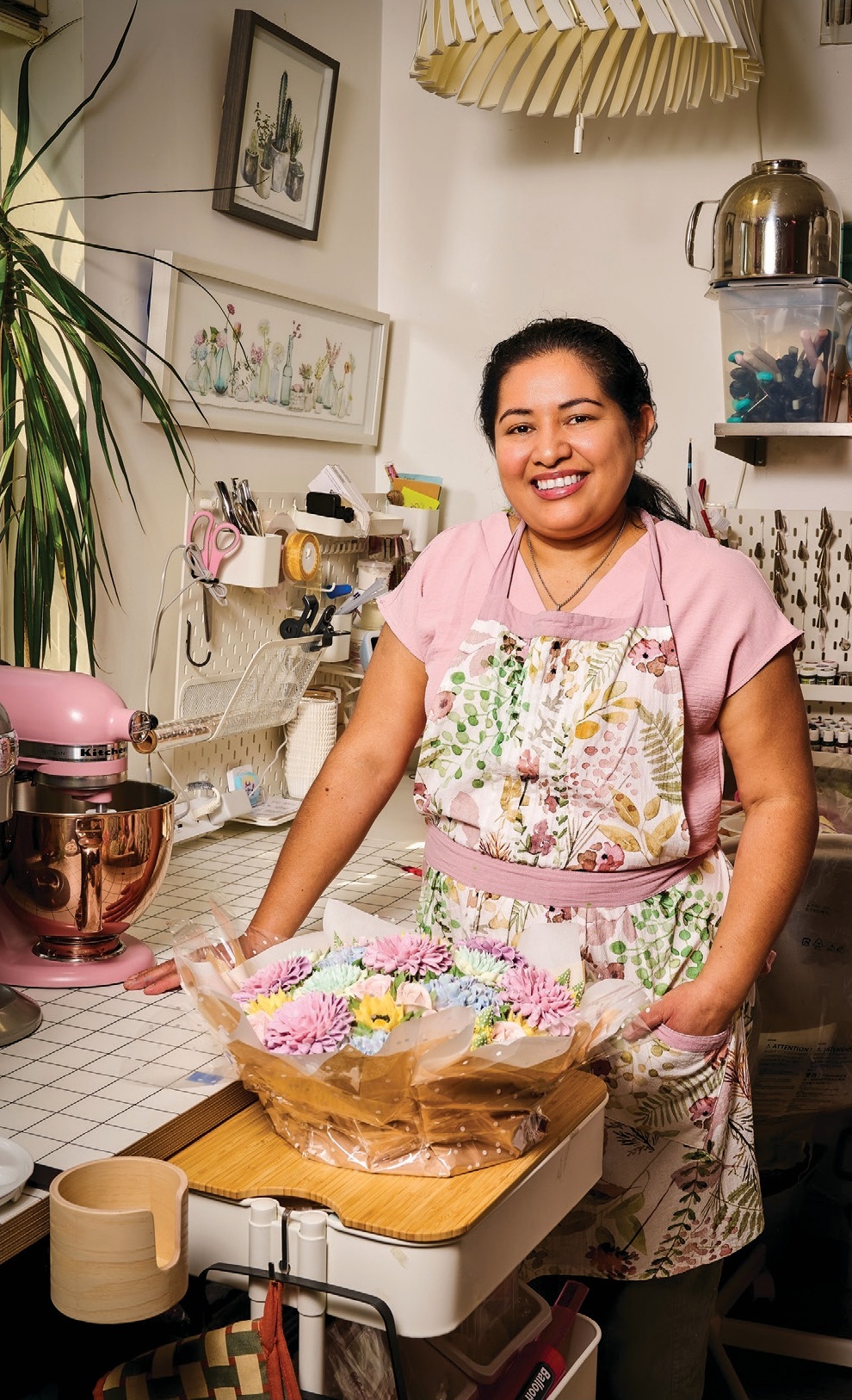
Jamaliyyih Perez
Jam Sweet Bouquets
Since childhood, Jamaliyyih Perez has been sweet on baking. She tried to attend pastry school as a teenager in El Salvador but was too young. At 21, she emigrated to the States and started a family but kept accumulating baking gear and working on projects, such as creating the perfect tres leches cake for her young daughter and baking with the children she nannied.
During the pandemic, Perez got out her baking equipment and began watching YouTube videos about cupcake decoration, including how to create ravishing flowers out of icing. After much practice, she posted a picture of her floral cupcakes on Facebook. A friend asked if she’d make some for a birthday, and from there her business bloomed. “My abuelita taught me that when you cook, you put your heart into it,” she says. “The food tastes better because your love is in there.”
The 40-year-old cupcake artist offers four flavors—vanilla bean, chocolate, red velvet, and lemon with poppy seeds—each topped with vanilla buttercream elaborately shaped into hibiscuses, hydrangeas, poppies, and sunflowers. Her signature creation is a head-turning bouquet made with a dozen cupcakes. Customers order online and pick up their confections at her Arlington apartment. @JamSweetBouquets on Instagram.

Michael Kempner
Il Mulino Oltremare di Sargasso
Cooking for two decades at Obelisk, 2 Amys, and Etto ignited Michael Kempner’s love for wood-fired baking. Then came a life-altering stint at Elmore Mountain Bread, a highly regarded rural bakery in Vermont. After building a brick oven with a gabled roof in his Chevy Chase backyard, the 45-year-old began selling breads made with stone-milled flours in 2021, and it’s now his full-time job.
Every Saturday, he bakes 60 loaves, divided between a wheat-rye sourdough; toasted walnut; baguette-like filone; anadama, made with polenta and lightly sweetened with molasses; and whole grain studded with sesame, sunflower, and flax seeds. “It’s a juggling act of shaping loaves, baking, cooling, and then packing and labeling,” he says.
Kempner also turns out gleaming challahs, darkly caramelized canelés, bittersweet chocolate babka, and several cookies. At 3 PM, he opens his home for pickups of preorders and to sell any remaining goods: “It’s like a fourth-grade lemonade stand in my front yard—I have a little market table.” SargassoBread.com.
PHOTOGRAPHS BY LAUREN BULBIN
TASTE / HISTORY
Is Your Bartender a Spy?
A look at espionage in DC restaurants

EARLIER THIS YEAR WHEN COMPASS coffee declared bankruptcy, right-wing provocateur Laura Loomer alleged that Qatar’s sovereign wealth fund was angling to buy the DC chain in order to use its wi-fi networks to spy on government-connected customers. No actual evidence of such a scenario existed, and Compass Coffee was ultimately bought in a bankruptcy auction by London-based Caffè Nero. But the rumor did get us thinking about spy activity in DC restaurants. Turns out there’s a history of it.
During the Cold War in 1985, CIA officer turned double agent Aldrich Ames handed over US secrets to the Soviets at Chadwicks (now Mr. Smith’s) in Georgetown. That same year, at nearby Au Pied de Cochon, KGB officer and Soviet defector Vitaly Yurchenko escaped his CIA handler and defected back to the Soviet Union. (The French bistro had a plaque to commemorate his last meal in the US.) More recently, FBI agents surveilled former senator Bob Menendez with Egyptian officials at the downtown Morton’s steakhouse, leading to charges of bribery, extortion, and acting as a foreign agent for Egypt.
“Every week, there’s foreign-intelligence officers meeting with people in restaurants in DC,” says Peter Strzok, a former special agent for the FBI. “If they’re interesting enough to the FBI, there’s a decent chance the FBI might be trying to watch that.”
Chris Costa, executive director of the International Spy Museum, says intelligence officers might also frequent certain hangouts, such as around the White House: “If you are a trained intelligence officer, you’re going to the restaurant with the express purpose of developing and cultivating a source that has access to the White House. Also, in some cases, you do intensive research. What looks like somebody bumping into you at a bar could be somebody that already knows who you are and knows that you work for the White House.”
Spies could potentially be making your coffee or serving you a glass of wine, too. “The idea of having cover work—something mundane and boring—but having some other special task, that is not unusual at all,” Costa says.
Still, a cover requires a lot of effort, and Strzok notes that it’s unlikely an intelligence officer would be spying from a restaurant position, just hoping to overhear something interesting. But, he adds, there is a “high” likelihood that some local bartenders have been recruited to provide information—though they may be misled about whom they’re really working for. (A foreign operative could be disguised as, say, a journalist to gain their cooperation.) “Return-on-investment-wise, it’s much better to recruit a couple of bartenders and say, ‘If you hear something interesting, give me a call and I’ll pay you for the information,’ ” Strzok says.
As for weaponizing the wi-fi network at a coffee shop? According to Strzok, a cafe near the White House or a US intelligence facility may be a tempting target for a foreign government to monitor, but weeding through the data overload—even with the aid of AI tools—might have limited success. “For every US Army Special Forces guy that sits down, there are 2,000 customers who have nothing to do with the US government,” he says. “And that one person, they might be sloppy, but chances are they’re not going to be plopping down and hopping on the internet and all of a sudden discussing classified or sensitive information.”
PHOTO-ILLUSTRATION BY ALICE ASHE


HOME

UPWARD TREND
Turn the page to see how this Del Ray home was designed for maximum eco-efficiency while keeping livability and style in mind.
PHOTOGRAPHS BY JENNIFER HUGHES
HOME / DESIGN
Eco-Efficient Living
How one architect designed a net-zero home for a family of six in Del Ray
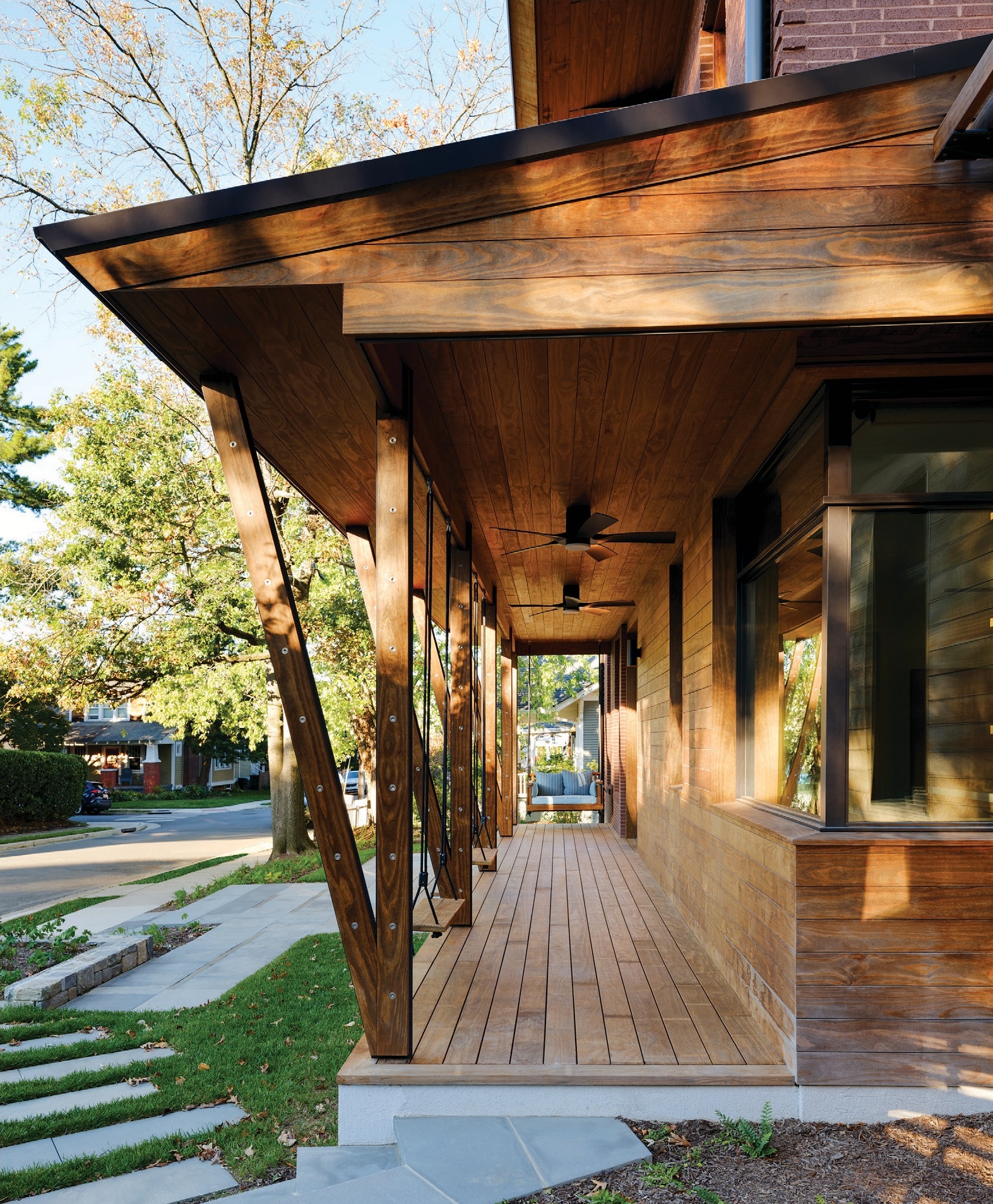
Four-foot roof overhangs offer shade outside while protecting the front windows from the sun’s heat.
DESIGNING AN 8,200-SQUARE-FOOT home for a family of six is ambitious enough—but making it eco-friendly and able to produce more energy than it uses? That might sound impossible.
“The size was its biggest challenge,” says architect Deborah Buelow of Cedar Architecture in Alexandria. “It’s a big space, and that’s not easy to make a net-zero home.”
The family wanted more than energy efficiency—they envisioned what’s known as a net-positive, certified-passive, extreme-energy-efficient home, meaning it would power itself, store surplus energy for emergencies, and even feed electricity back to the grid. To receive its certified status from the Passive House Institute of the United States, the home required airtight insulation, a constant-ventilation system, a solar roof, and thermal heating and cooling.
“If this house had been built in a traditional manner, it would use more than three times as much energy as it does now,” Buelow says.
From the start, there were obstacles. The half-acre site had an irregular shape, cobbled together from three lots. After demolishing the existing structures, Buelow began designing, taking into consideration that while her clients wanted a spacious home, they also wanted it to blend in with the character of their Del Ray neighborhood in Alexandria.
To achieve this, Buelow had the front of the house built out of brick made in North Carolina from 100-percent recycled ceramic materials. For the rest of the exterior, she used Kebony wood, a sustainable eco-treated pine that starts brown but weathers to a silvery gray. The homeowner added his own whimsical touch to the front porch by handcrafting swinging chairs from scrap wood.
“We brought the brick in as a way of kind of speaking to the Colonial style, but then wrapped the front of the house in wood to still give it a contemporary feel,” Buelow says. “And the wood will last forever. This type will never have to be replaced, painted, or coated. You never have to do anything to it.”
THROUGHOUT THE PROCESS, BUELOW prioritized incorporating nature into the design. While the house’s south-facing orientation captures abundant sunlight, generous four-foot roof overhangs shade the front windows from the high sun and prevent overheating during summer.
Other natural touches include slate flooring, rain roof gardens with native plants, and natural-grass wall coverings. Circadian bulbs in the Ketra intelligent lighting adjust during the day to mimic natural outdoor light. At the rear of the house, 16-foot-wide floor-to-ceiling sliding doors made by Zola draw in light and views of the back garden.

Facing the backyard, 16-foot sliding doors allow natural light and garden views.

The kitchen is all electric, including an induction cooktop in the island.
To preserve the interior climate, triple-pane windows and insulated doors were installed. The walls are 16 inches thick, including four inches of exterior insulation—creating a tight thermal envelope. The front door is secured with a bolt system in five places, keeping it tight to the frame to ensure that no air slips in or out when the door is closed.
“Any gaps in the exterior—whether through windows, doors, or wiring—pull air out and cause heat loss,” Buelow says.
Inside is where the true energy efficiency is on display. After creating the sealed environment, a circulation system moves air throughout the house and continuously draws in filtered outdoor air. The kitchen operates entirely on electricity, including an induction cooktop in the island that boils water in minutes while keeping cool to the touch—a necessary safety feature for a household with four young children.
But the house has an equally impressive design. Despite its large footprint, individual rooms were configured on a more intimate scale to keep from feeling overwhelming. To create a seamless flow, Buelow established transitional zones between rooms, giving each area a distinct function. White-oak slats affixed to the front entry’s ceiling and walls, along with a modern hanging light fixture, create an elevated atmosphere for welcoming visitors. A separate mudroom entrance—with built-in benches; storage for coats, shoes, and backpacks; and laundry and plant potting stations—provides a practical space for everyday comings and goings.

Starting at the entry, transitional areas give each space a distinct function.
“We were aiming for spaces that are comfortable and not just about grandness, more about how a family actually uses the house,” Buelow says. “We spent a lot of time thinking about what they need in each room.”
An eye-catching central staircase, created by Treenet Collective, serves as a sculptural focal point, its “rainbow whirl” design featuring multicolor paracord typically used by rock climbers. Two slowly moving fans over the staircase circulate air, and the staircase is flanked on both sides by a three-story curtain window-wall that provides natural light deep into the home’s interior.
A MECHANICAL ROOM IN THE BASEMENT serves as the hub for the house’s energy efficiency. Integrated Tesla Solar roof panels feed power into smart panels in the room. A battery backup system stores the excess, up to three days’ worth of electricity, meaning that the homeowners might never even pay an electric bill.
“The amount of solar supply from the panels equals just a little bit more than the amount of energy this house requires,” Buelow says.
The home also has a geothermal heating-and-cooling-exchange HVAC system. It consists of three wells in the driveway that circulate water on a continuous loop via pipes that extend 300 feet underground. Because the water circulates through a constant underground temperature, it can keep the house’s temperature fairly constant and cut heating and cooling costs by 20 to 50 percent, Buelow says. Maryland, Virginia, and DC offer incentives and tax credits for installing geothermal electricity-based heating systems.
With changing climates and escalating heating and cooling costs, Buelow expects more homeowners to look into eco-friendly options when updating, renovating, and building homes. Though constructing a net-zero house of this type may cost 5 percent more upfront, she says, lower utility bills over time can make the investment worthwhile.
“The demand is growing as people are learning about the benefits,” Buelow explains. “Building codes are going to be requiring you to build with more energy efficiency anyway. People are going to have to understand that it’s going to have to be part of their homes and that your home can be the house you want and also be energy-efficient.”


Claudia Rosenbaum is a freelance culture writer whose work has appeared in the New York Times, Vulture, Eater DC, and Vanity Fair. On Instagram, she’s @CJRosenbaumReports.
PHOTOGRAPH ON LEFT BY JUSTIN PAGET/GETTY IMAGES; RIGHT BY BRIZMAKER/GETTY IMAGES
HOME / REAL ESTATE
Top Mortgage Professionals
Buying a home or refinancing? You’ll need a good loan officer. These are the leading ones in the area.

INTEREST RATES, POINTS, OPTIONS, EQUITY—there’s a lot to consider when it comes to the mortgage part of buying a home, and having a savvy expert in your corner can make all the difference. A good loan officer not only can guide you through the process in a way that makes you feel secure but can help you land your dream home.
To determine the list of Best Mortgage Professionals in the area, we surveyed almost 9,000 readers, more than 1,200 real-estate agents, and 68 title companies, asking which lenders they most recommend. The 103 names here are the ones that came up again and again.
To compile our second list, Elite Producers, we asked financial institutions for the names of their top mortgage originators for 2025—the ones with at least $60 million in sales for our platinum status, $45 million for our gold level, and $30 million for our silver roster.
While these serve as handy guides, they’re not exhaustive lists of excellent lenders in our area—they reflect only those names that came up in our surveys.
BEST MORTGAGE PROFESSIONALS
These individuals were recommended most by local real-estate and title-and-closing agents and by Washingtonian subscribers.
ELITE PRODUCERS
PLATINUM
Individuals with $60 million or more in mortgage volume during 2025
GOLD
Individuals with $45 million to $59.9 million in mortgage volume during 2025
SILVER
Individuals with $30 million to $44.9 million in mortgage volume during 2025
PHOTOGRAPH BY MARIA MANCO/STOCKSY
















HOME / NEIGHBORHOOD BRIEFING: DUPONT AND LOGAN CIRCLE
The Briefing
Dupont Circle and Logan Circle
Great places to eat, drink, shop, and play in these Northwest DC neighborhoods–including old haunts worth another visit.

The hotel eatery Casamara
BUILT AFTER THE CIVIL WAR TO FULFILL Pierre L’Enfant’s grand plan for Washington, the traffic circle then called Pacific Circle—later renamed for Union general Samuel Francis Du Pont—began shaping the Dupont Circle neighborhood that we know today. Over the decades, the area expanded with an influx of embassies, shops, restaurants, and residences. Meanwhile, its neighbor to the east, Logan Circle, experienced a similar bout of development as Victorian rowhouses sprang up and nearby14th Street cemented itself as a major retail destination.
Both areas took a hit after the 1968 riots but bounced back, thanks in part to a surge of LGBTQ+ residents. Today, they’re among the city’s buzziest neighborhoods, with plenty of places to eat, shop, and have fun. Here are some new spots as well as old favorites.
WHERE TO EAT AND DRINK
Standing Room Only
Probably DC’s only pasta restaurant with no chairs, Gemini (1509 17th St., NW) is one-of-a-kind in more ways than one. It’s a natural-wine shop, an ice-cream parlor, and a sourdough-pizza place, but it truly shines with pastas such as Greek gnocchi, called gkogkes, in tomato butter and small plates like roasted Japanese sweet potato with feta. Gemini, which opened in 2023, has an undeniable pedigree, too: It’s run by chef Johnny Monis, who was behind Komi and Little Serow, two of the most beloved and distinctive Washington restaurants of the past few decades.
Back in Action
Last year, chef Paolo Dungca announced the closure of his hip, modern Filipino restaurant on H Street. Less than two months later, Kayu (1633 17th St., NW) was back with a cozy new dining room in Dupont Circle. Try Dungca’s decadent cassava cake topped with crab fat, jamón Ibérico, and trout roe; chorizo sliders with pickled papaya; or the grilled half chicken with spicy vinegar.
Bowls From the Balkans
For the past five years, Zeleno (1605 Connecticut Ave., NW), a cozy health-food cafe, has been serving avocado toast and açai bowls in a space decorated with plants and a wall of cross-sectioned trees. Look closer, though, and you’ll find some items that reflect the owners’ Bulgarian background: The Bulgarian yogurt bowl is a perfect light breakfast.
Boutique Mystique
The luxe Sixty Hotel appeared on the Dupont scene last year, bringing with it the coastal Mediterranean eatery Casamara (1337 Connecticut Ave., NW). Restaurateur Hanif Harji draws on numerous cuisines, serving such highlights as grilled-cabbage salad with yogurt-tahini dressing; sardine sourdough toasts; and braised pork shoulder with candied-pear mostarda. The wood-paneled Reynold’s Bar around the back of the hotel is also a draw.
Viva México
Chihuahua-born chef Christian Irabién opened one of DC’s best Mexican restaurants in 2023. Amparo Fondita (2002 P St., NW) feels buzzy and cool at dinner—look for ceviches or aguachiles, plus festive large plates like chile en nogada—but we also recommend the set lunch, inspired by the quick multi-course comida corrida tradition in Mexico City.
Hygge Hut
Opened in 2018 by the former executive chef for the ambassador of Finland, Mikko Nordic Fine Food (1636 R St., NW) embraces hygge, the Scandinavian term for a feeling of cozy contentment. You’ll find Danish open-faced sandwiches with gravlax or shrimp on rye bread, Swedish pancakes, and hearty main courses like chicken schnitzel with caper butter. It’s also a good place to stop for just a hot toddy, hot chocolate, or glögg (mulled wine).

Dupont Underground, a cultural hub
P Street Pizza
Fine-dining chef Russell Smith aimed to perfect a New York–ish style of thin-crust pizza when he opened Alfreda (2016 P St., NW) in 2024. What he came up with is a laid-back neighborhood spot with indulgent yet simple pies. The Alfreda—with crushed tomato, fresh and aged mozzarella, romano, oregano, and black pepper—is somehow more than the sum of its parts.
Tandoori Trend
When a team of Indian chefs opened Pappe (1317 14th St., NW) in 2018, it was the only Indian restaurant along 14th Street. It also helped usher in a boom in creative yet traditional South Asian restaurants that has made DC’s Indian food scene even more exciting. Some of the best dishes on the menu are kissed by an open-fire grill: Tellicherry lamb chop, chicken tikka masala, and fresh naan. Pappe’s particularly powerful vindaloo is another specialty.
Subterranean Street Food
Drawing inspiration from Bangkok’s buzzing Chinatown, Andy and Billy Thammasathiti opened Sura (2016 P St., NW) in 2022. They describe the underground space as an “izakaya” or tavern, and serve great drinking food, such as sesame chips with peanut-curry/pork dip, spicy duck laab, and wok-fried pork-belly rice. Wash it all down with house cocktails, beer, or sake.
SC to DC
Former Vidalia chef Hamilton Johnson opened Mallard (1337 14th St., NW) in 2024 just off Logan Circle. Dishes such as pimiento cheese with Ritz crackers and chow chow; Sea Island pea dip; shrimp and grits with country ham; and blue-catfish schnitzel draw from Johnson’s South Carolina roots, as does the vintage-Americana decor.
Beyond Barbecue
Named after the earthenware pots that Koreans traditionally use to ferment kimchi, Onggi (2100 P St., NW) opened last year. Delicate side dishes such as marinated perilla leaves, mountain vegetables, white-pear kimchi, and stir-fried anchovies are refined, but there are also bigger flavors, including kimchi-pork stew, grilled short ribs, and bone broth with noodles. A jeongsik set-lunch special—your choice of stew or protein such as grilled bulgogi or mackerel, accompanied by three sides and multigrain rice—is an affordable way to taste the products of Onggi’s kitchen.
SHOPPING AND THINGS TO DO
Taking a Page
In addition to a wide-ranging selection of reads, Black-owned Solid State Books (1809 14th St., NW) offers mindfulness workshops, craft circles, and monthly book clubs—themes include romance, mystery, and LGBTQ+. For $50, you can secure a yearlong membership, which grants access to discounted books and event tickets at both the Logan Circle store, which opened in late 2023, and the original location on H Street, Northeast.
Out of the Woods
Utah sporting-goods retailer Backcountry (2108 14th St., NW) chose Logan Circle as the site for its first Washington-area store in 2023. Shoppers can find apparel and equipment for skiing, cycling, camping, and more, including products from outdoor lifestyle brands like Patagonia, the North Face, and Sorel.
Eye Candy
Warby Parker (1629 14th St., NW) opened its sixth DC outpost in Logan Circle last November. The eyewear retailer offers a variety of accessories—prescription specs, contact lenses, sunglasses—plus eye exams. This location boasts three exclusive pieces of artwork by French illustrator Lisa Laubreaux, which are great for ogling.
Branching Out
Netflix-loving locals might remember when Plntr (1825 18th St., NW) was featured as a date spot in the 2024 DC season of Love Is Blind. The plant boutique, which opened in Dupont in 2020 and expanded to Crystal City last year, offers all kinds of greenery—plus accessories, gardening supplies, and repotting services. It also hosts floral arrangement and other craft classes, including card-making and even an herbal-tea-making intensive.

Yoga with puppies at Puppy Sphere
Downward Dog
Puppy Sphere (1638 R St., NW), a chain of puppy yoga studios, brought its adorable operation to Dupont Circle last spring. A $60 ticket gets you access to a 45-minute beginner-friendly yoga class followed by a half-hour snuggle session with pups from local breeders and rescue groups, plus sparkling mocktails.
Glow Up
The second DC location of the buzzy facial haven Glowbar (1450 P St., NW) arrived in Logan Circle last winter. Facials are performed by licensed aestheticians, who customize services to each client’s skincare needs using techniques like dermaplaning, chemical peels, and LED light therapy. A $65 monthly membership fee includes one facial each month, plus exclusive merch and discounts on Glowbar’s skincare line.
Watch Yourself
Shinola (1631 14th St., NW) brought its selection of leather-bound timepieces to Logan Circle in 2015, marking the Detroit brand’s third flagship location. In addition to its signature watches, collections include artisan bags, jewelry, and even pet accessories.
Vintage Vibes
Owned and operated by its founder, Caitrine Callison, since 1986, Secondi (1702 Connecticut Ave., NW) is widely recognized as DC’s longest-standing women’s consignment shop. The racks boast a staggering selection of secondhand designer finds—think Gucci bags, Christian Louboutin heels, and David Yurman jewelry—for a fraction of their original price.
District of Decor
Founder Amanda McClements expanded her do-it-all housewares shop, Salt & Sundry (1625 14th St., NW), to Logan Circle in 2014, two years after opening her original Union Market location. Shop her selection of goodies by local and artisanal makers, including candles, jewelry, leather goods, handmade ceramics, and decor.
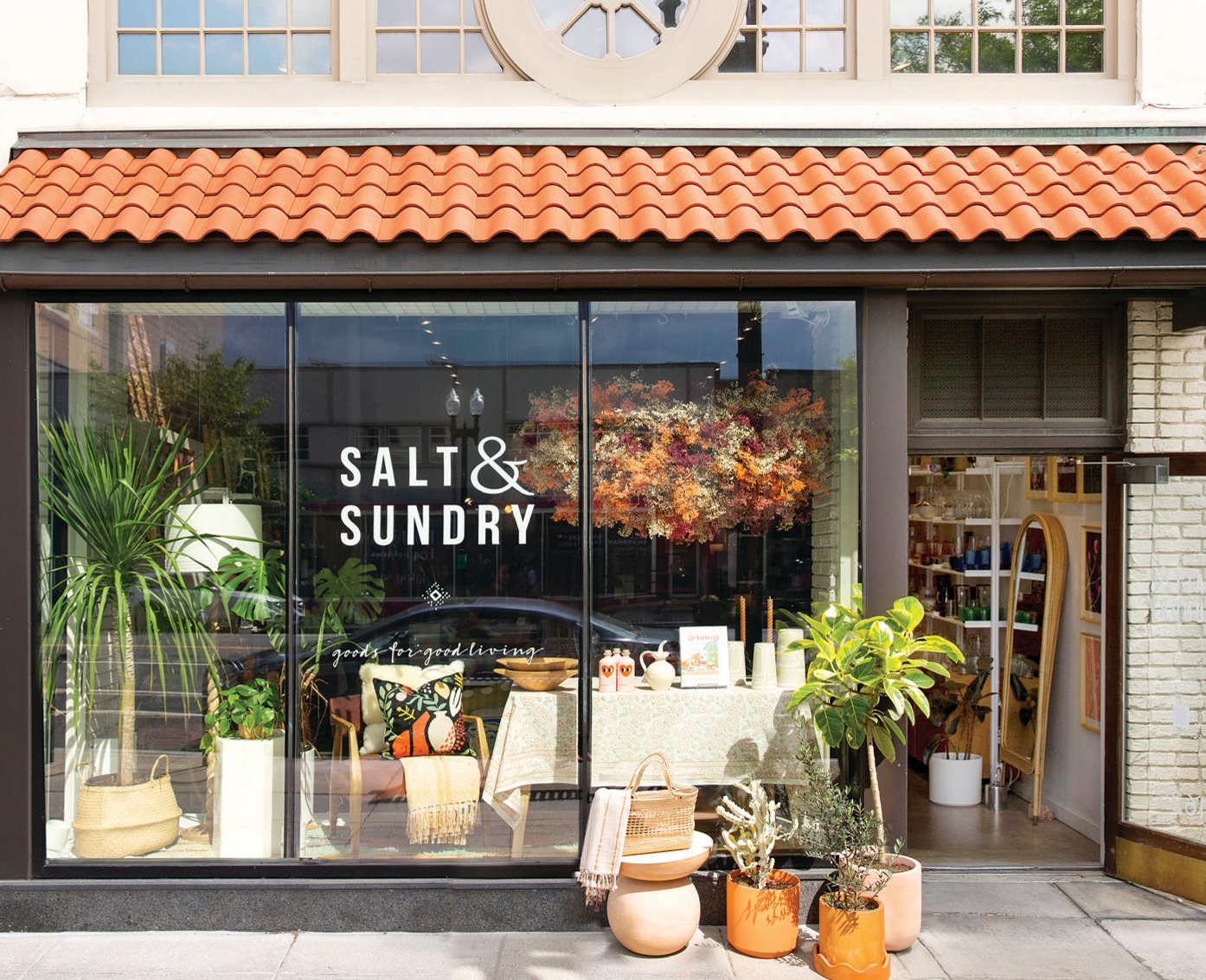
Salt & Sundry for home goods
On the Market
The Dupont Circle FreshFarm Market (1600 20th St., NW) has been a weekend tradition since 1997. Every Sunday from 8:30 to 1:30, more than 50 farmers and artisans gather to sell the fruits of their labor. Along with produce, local businesses offer coffee beans, baked goods, condiments, and more.
Stage Right
Known for its intimate 200-person auditorium, Logan Circle’s Studio Theatre (1501 14th St., NW) has been a cornerstone of DC’s performing-arts scene since it opened in 1978. On the marquee this spring: Purlie Victorious, a Tony-nominated satirical comedy about a reverend who travels through Jim Crow–era Georgia to save his father’s church.
Rocking On
In a city that’s full of music venues, the Black Cat (1811 14th St., NW) still stands out more than three decades after its founding by former Gray Matter drummer Dante Ferrando. Upcoming headliners include British punk rockers Mclusky, the twee pop band Heavenly, and indie pop singer-songwriter Ritt Momney.
Picture-Perfect
Founded by art collectors Duncan and Marjorie Acker Phillips more than a century ago, the Phillips Collection (1600 21st St., NW) houses nearly 6,000 works by artists including Pierre-Auguste Renoir, Vincent van Gogh, Edward Hopper, and Georgia O’Keeffe. Through early May, visitors can see the exhibition “There Somewhere,” a video installation showcasing the work of artist Peter Campus.
House Tour
In the early 1900s, American diplomat Larz Anderson and his wife, Isabel, threw their share of soirees at what’s now the historic Anderson House (2118 Massachusetts Ave., NW). Today, the Gilded Age mansion is overseen by the Society of the Cincinnati and operates as a museum for the public to tour. Artifacts from the couple’s many extravagant trips abroad remain on display, from Asian ivories to French home furnishings.
Art Down Below
Dupont Underground (19 Dupont Cir., NW) opened in 2016, reimagining a deserted streetcar station into a nonprofit cultural hub. The space hosts a wide variety of programming, including poetry readings and fashion shows. Coming this spring: an adaptation of Tennessee Williams’s A Streetcar Named Desire featuring only four actors and no set or props.
History Lesson
Mary McLeod Bethune used her Logan Circle home as headquarters for the National Council of Negro Women, an organization she founded in 1935 to advocate for the interests of Black women. Today, the Mary McLeod Bethune Council House (1318 Vermont Ave., NW) is recognized as a National Historic Site. Visitors can take guided tours on Thursdays, Fridays, and Saturdays. W
WHAT’S SELLING
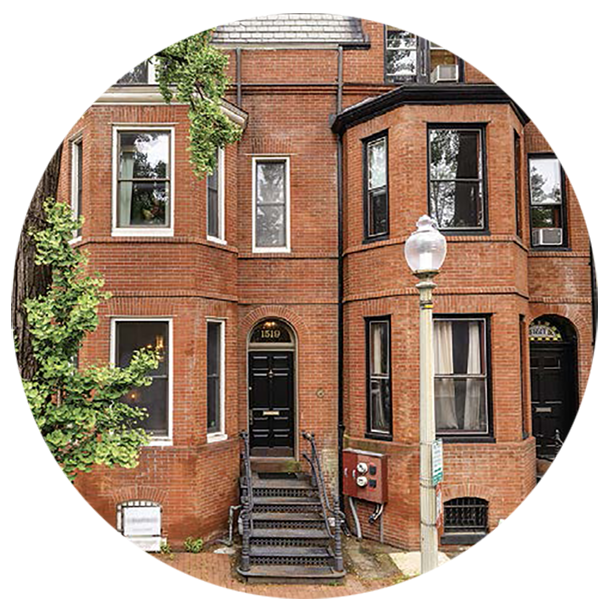
The historic neighborhoods of Dupont and Logan circles–epicenters of DC life–are dotted with old condos, townhouses, and a few luxury buildings. Here’s what’s sold in the past few months.
$365,000
A 600-square-foot condo in Logan Circle’s 1225 Lofts building with one bedroom, one bathroom, and large windows.
$675,000
A 1908 Dupont Circle condo with two bedrooms, two bathrooms, a fireplace, and lots of natural light.
$900,250
A two-floor loft in the St. John’s Wood building in Logan Circle with two bedrooms, two bathrooms, high ceilings, a private balcony, and two assigned parking spaces.
$1,440,000
A Dupont Circle townhouse, built in 1885, with three bedrooms, two and a half bathrooms, a den, two fireplaces, a backyard, and a separate two-bedroom apartment.
$2,012,000 (shown above)
A late-1880s three-story townhouse in Logan Circle with 2,760 square feet of living space, including five bedrooms, two and a half bathrooms, five fireplaces, and a deck.
PHOTOGRAPHS: PAULA WILSON/COURTESY OF CASAMARA; COURTESY OF SALT & SUNDRY; (PHOTOGRAPH OF HOUSE) DEREK & VEE; (DUPONT UNDERGROUND) CAMILA OBSCURA; PUPPY SPHERE







HOME / LUXURY HOMES
Off the Market!
A peek inside some of Washington’s recent high-end residential transactions
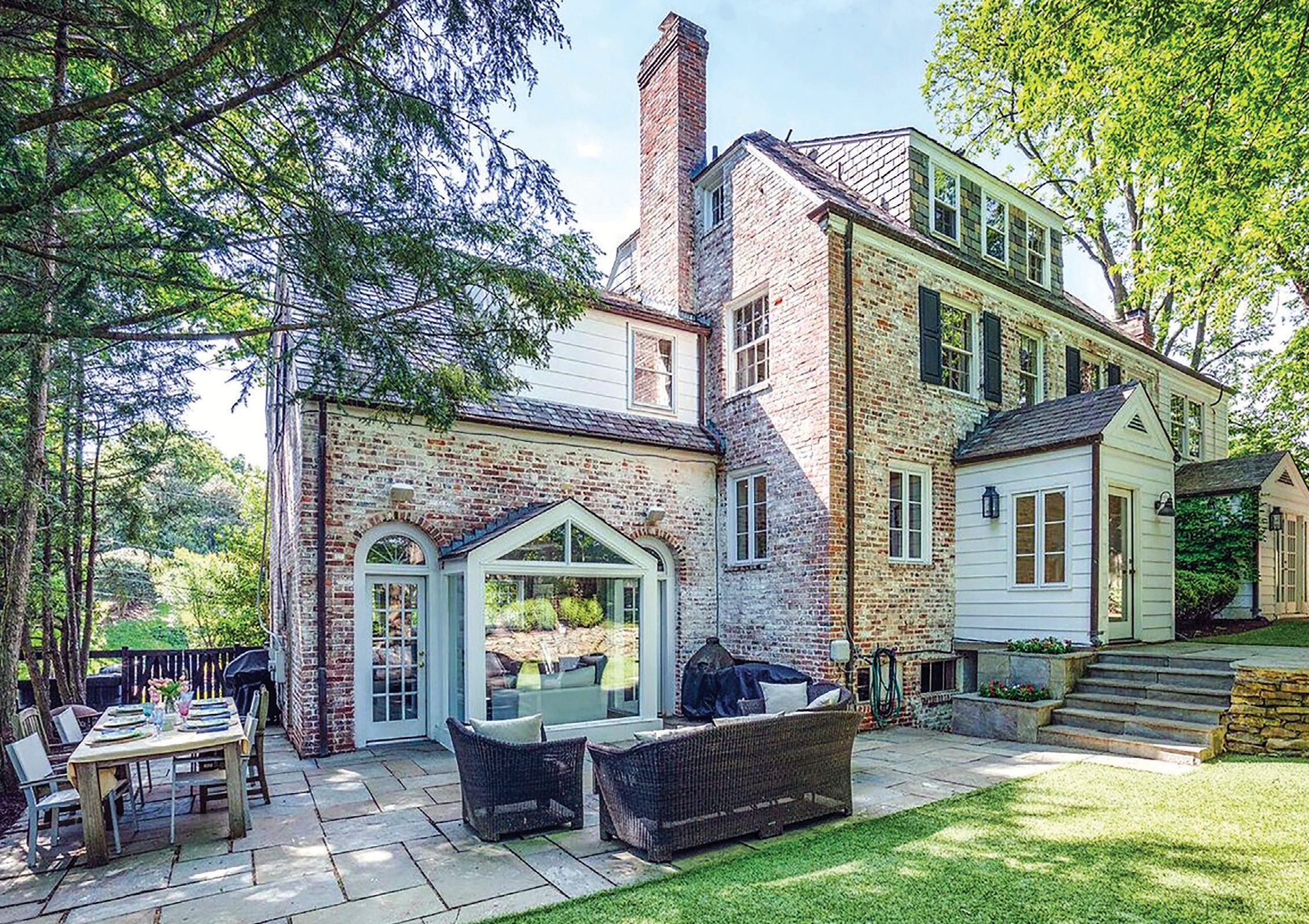
DC
1 WHERE: Wesley Heights.
BOUGHT BY: Alex Velinsky, a partner and finance lawyer at Morgan Lewis, and Elizabeth Velinsky.
LISTED: $3,550,000.
SOLD: $3,300,000.
DAYS ON MARKET: 214.
BRAGGING POINTS: A renovated 1940 Colonial with six bedrooms, five and a half bathrooms, a dining room with cathedral ceilings, a recreation room, a flagstone patio, and a fenced backyard.

2 WHERE: Georgetown.
BOUGHT BY: Madeline M. Grayson, cofounder of Tuckernuck, and Paul C. Grayson, a principal at BG Ventures.
LISTED: $5,995,000.
SOLD: $5,995,000.
DAYS ON MARKET: 9.
BRAGGING POINTS: An 1850s brick house with seven bedrooms, seven bathrooms, two half baths, three fireplaces, a grand foyer, a double-parlor living room, a library, a flagstone terrace, a brick patio and garden, and a pool with a pool house.
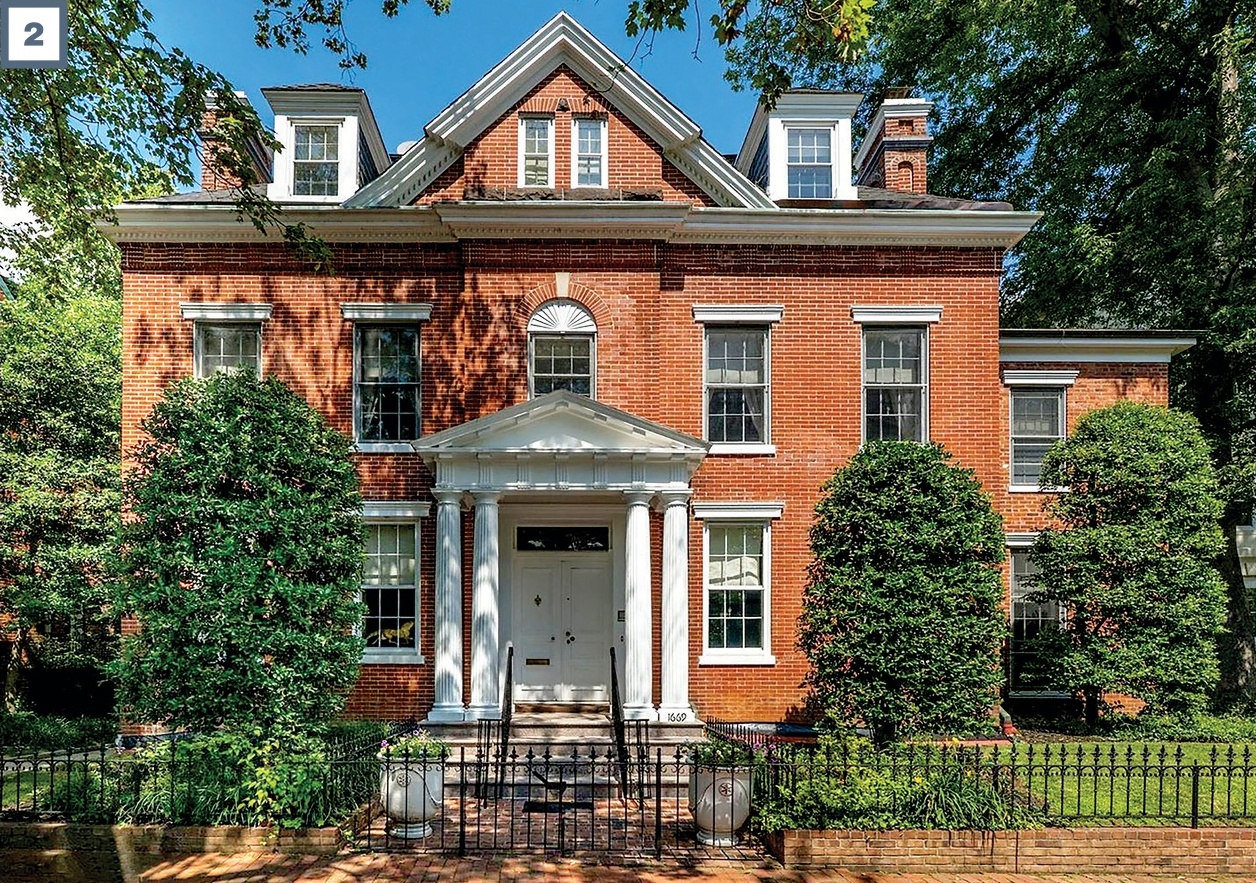
WHERE: Berkley.
SOLD BY: Jason L. Twomey, a financial adviser at Oppenheimer & Co., and Melissa H. Twomey, founder and principal of VisionArt Consulting.
LISTED: $5,999,000.
SOLD: $5,999,000.
DAYS ON MARKET: 12.
BRAGGING POINTS: A Neoclassical-style mansion with six bedrooms, five and a half bathrooms, three fireplaces, a reception area, a library, a recreation room, a dining patio, a loggia, a pool terrace, and an English garden.
MARYLAND
3 WHERE: Bethesda.
SOLD BY: Susan L. Furbay, a hospitality-real-estate investment professional.
LISTED: $3,599,000.
SOLD: $3,550,000.
DAYS ON MARKET: 105.
BRAGGING POINTS: A transitional-style home with five bedrooms, five bathrooms, two half baths, two fireplaces, a library, a recreation room, a front porch, and a tree-lined backyard.

WHERE: Chevy Chase.
BOUGHT BY: David M. Uhlmann, former EPA assistant administrator, and Virginia E. Murphy, a professor at the University of Michigan.
LISTED: $3,195,000.
SOLD: $3,000,000.
DAYS ON MARKET: 38.
BRAGGING POINTS: A new three-story house with six bedrooms, five and a half bathrooms, two fireplaces, an elevator, a large recreation room, a covered patio, and a rear porch.
VIRGINIA
4 WHERE: McLean.
SOLD BY: Former Washington Caps center Nicklas Backstrom.
LISTED: $11,995,000.
SOLD: $11,000,000.
DAYS ON MARKET: 188.
BRAGGING POINTS: A 17,135-square-foot estate with seven bedrooms, seven bathrooms, five half baths, six fireplaces, dual staircases, an elevator, a catering kitchen, a sauna, a theater, a gym, a recreation room, and a resort-style pool area.

WHERE: McLean.
BOUGHT BY: James M. Roth, an author and former CIA officer.
LISTED: $7,395,000.
SOLD: $7,200,000.
DAYS ON MARKET: 116.
BRAGGING POINTS: A custom-built home with five bedrooms, five bathrooms, three half baths, five fireplaces, an elevator, a two-story foyer, a library, a theater, a fitness room, an outdoor kitchen, a saltwater pool, and a four-car garage.
Sales information provided by Bright MLS.
PHOTOGRAPHS: HOMEVISIT/COURTESY OF VICTOR MADDUX/COMPASS; NATHAN STEWART; HOME VISIONS MEDIA; COURTESY OF SHERIF ABDALLA/COMPASS

FIRST PERSON
Civil-Rights Lawyer Debra Katz on Two Keepsakes That Inspire Her
Together, her father’s bongos and a Jewish shofar symbolize resilience and a call to help fix the world

Herbie Katz on his bongos in 2018. “There’s something very sweet about touching the skins and knowing my dad’s hands were on them,” his daughter says.
IN HER OFFICE ABOVE DUPONT CIRCLE, DEBRA KATZ SHOWS me a newspaper clipping about her father, Herbie Katz: RHUMBA HEP CAT ‘EL GATO’ ACHIEVING LOCAL SUCCESS reads the headline on a profile of a handsome fellow who improbably had found his way into New York’s Latin music scene—a job he pursued from the late 1940s until he had a second child in the ’60s and joined the family box-making business instead.
Herbie’s bongos are among Katz’s prized possessions, a way to remember her dad, who died in 2019. But during President Trump’s second term, the drums—as well as a shofar, a trumpet crafted from a ram’s horn, used in Jewish rituals—have even deeper meanings for Katz, a prominent employment and civil-rights lawyer whose clients have included Brett Kavanaugh’s accuser Christine Blasey Ford, former NIH official Jeanne Marrazzo, and Andrew Cuomo accuser Charlotte Bennett. Here Katz reflects on the meaning of these objects to her.
“MY DAD WAS A WORKING-CLASS kid from an immigrant family who grew up in the tenements in Brooklyn. His Russian grandparents would tell us, in their heavy Yiddish accents, ‘No Jewish children are Latin drummers!’ Despite that, my dad just fell in love with Latin music. His stage name was El Gato—the Cat. He played up in the Catskills in the age of the Borscht Belt. His band sometimes played before Lenny Bruce performed, and on occasion he played with Tito Puente.
“I keep my dad’s bongos in the living room, on my bookshelf. After he died, I took a few lessons—it turns out that playing the bongos is a lot harder than it seems. There’s something very sweet about touching the skins and knowing my dad’s hands were on them.
“His bongos help me stay strong during the dark period of history we’re in. I believe that finding pleasure in the midst of all of this is crucial. Growing up, I was taught about the obligation of tikkun olam, an important concept in Judaism that means ‘repairing the world.’ Listening to Latin music—a constant in our home when I was growing up—is a salve for me and a reminder that it’s our duty to protect our neighbors.
“I also have a shofar on my desk, given to me as an award by a social-justice group called T’ruah, after I represented Christine Blasey Ford before the Senate Judiciary Committee. The other day, T’ruah organized a loud and boisterous demonstration outside ICE headquarters in DC that I attended to protest the excesses of ICE and the killing of Renee Good and Alex Pretti. Rabbis came from all over the United States, and many played their shofars. The piercing sound of the shofar is a call for justice and a call to work to make the world whole.
“Music, my dad’s bongos, and this shofar—they all remind me to wake up, get out of my slumber, and do what I can. We can’t all do everything, but all of us can do something. That’s what I’m trying to stay focused on.”
—AS TOLD TO ANDREW BEAUJON
PHOTOGRAPH COURTESY OF DEBRA KATZ



CONTENTS
Done